Advanced Cancer Treatment in India: Guide for Bangladesh Patients
Reviewed by: Cancer Care Department
Posted on May 20, 2026
10 Min Read

Loading...

98, HAL Old Airport Road, Kodihalli, Bengaluru, Karnataka 560017
Accreditations


Copyright © 2025 Manipal Hospitals - All Rights Reserved
Reviewed by: Cancer Care Department
Posted on May 20, 2026
10 Min ReadCancer care has evolved rapidly over the past decade, with major advancements in diagnostics, surgery, radiation therapy, immunotherapy, and precision medicine transforming patient outcomes across the world. For many families in Bangladesh, that moment is quickly followed by a second, equally daunting question: Where do we go from here?, and seeking advanced cancer treatment abroad has become an important consideration, especially when dealing with complex or late-stage diagnoses that require multidisciplinary expertise and cutting-edge technologies.
Today, India has emerged as one of the most preferred destinations for international oncology care. From advanced breast cancer treatment and lung cancer treatment to highly specialized blood cancer treatment and colon cancer treatment, Indian hospitals offer comprehensive solutions backed by globally trained oncologists, modern infrastructure, and comparatively affordable treatment costs. Each year, tens of thousands of Bangladeshi patients travel to India seeking cancer treatment. They come for robotic surgery, proton therapy, CAR-T cell immunotherapy, and precision oncology protocols that match the best in the world.
This guide explores why India is increasingly becoming the destination of choice for Bangladeshi patients and what families should know before planning their medical journey. It covers everything from why India has become the preferred destination for cancer treatment in India for Bangladeshi patients to the specific hospitals that shape the journey. If you or someone you love is facing a cancer diagnosis and considering India as a destination for care, read this guide carefully, and share it with your family.
The decision to seek cancer treatment in Bangladesh versus traveling to India is rarely simple, and it is rarely made lightly. It involves weighing medical realities, financial constraints, visa logistics, and the emotional weight of being ill far from home. Yet year after year, the numbers tell a clear story: India is the destination of choice for Bangladeshi cancer patients, and the reasons are structural, not incidental.
Bangladesh has made remarkable strides in general healthcare over the past two decades. Life expectancy has risen, maternal mortality has fallen, and primary care infrastructure has expanded significantly. However, cancer care continues to face several limitations. Access to advanced oncology infrastructure remains concentrated in select urban centres, leading to long waiting periods and delayed diagnoses for many patients.
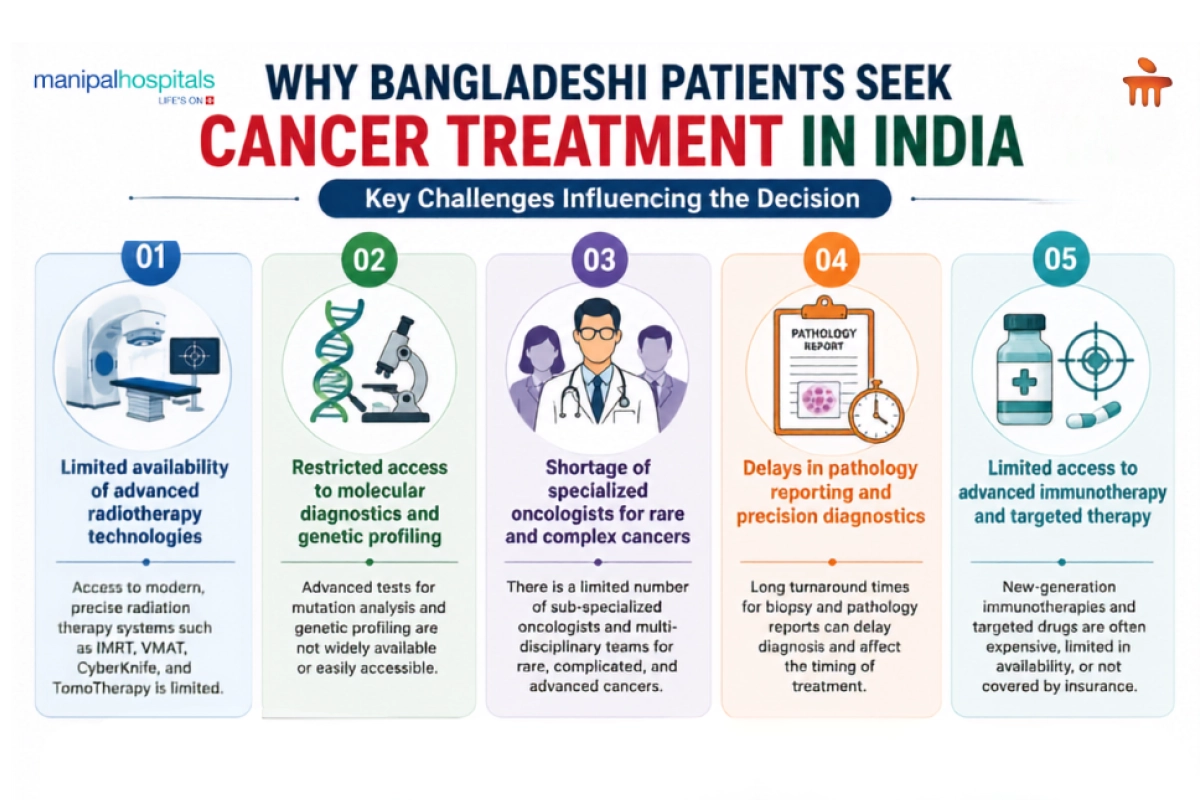
These challenges can significantly impact outcomes in aggressive cancers such as blood cancer treatment, cervical cancer treatment, and lung cancer treatment, where early intervention and precision-guided therapies are critical.
India has steadily become one of the largest medical tourism destinations for Bangladeshi citizens. Geographic proximity, cultural familiarity, linguistic comfort, and streamlined travel connectivity have contributed to this growth. According to many data sources, Bangladesh consistently ranks as the single largest source country, accounting for an estimated 30 to 40 percent of all international patients at major Indian hospitals, particularly in Kolkata, Bangalore, Vellore, and Hyderabad.
Geographic proximity is primary. Kolkata is closer to Dhaka than any other major Indian medical hub. This proximity reduces travel fatigue for patients and allows families to visit more frequently during long treatment courses.
Cultural and linguistic familiarity matters enormously when you are navigating a hospital in a foreign country. Bengali is widely spoken in Kolkata. Food, religious practices, and social customs are broadly familiar.
Cost advantage over Western alternatives is decisive. The affordable cancer treatments in India that hospitals offer, for procedures including bone marrow transplantation, robotic surgery, and immunotherapy, are less expensive than in other places.
Quality credentials have improved dramatically. Indian hospitals like Manipal Hospitals Global now hold international accreditations like JCI (Joint Commission International) and NABH and publish clinical outcomes data that is increasingly competitive with global benchmarks. The best cancer treatment in India is no longer simply "good for the price"; it is good by any standard.
For a Bangladeshi patient, this means the quality of care is assessed against the same international standards followed by top hospitals in countries like the United States and the United Kingdom — not just Indian benchmarks. JCI accreditation evaluates areas such as patient safety, surgical protocols, infection control, emergency response systems, and overall quality of care.
The result is a well-established corridor of care, supported by a mature ecosystem of visa agents, patient coordinators, travel facilitators, and diaspora communities that make the practical logistics of seeking treatment in India far more manageable than they once were. Additionally, Manipal Hospitals now offer dedicated international patient services specifically tailored for Bangladeshi families.
India’s oncology ecosystem combines medical expertise with highly advanced treatment technologies. Patients can access integrated cancer care for both common and complex malignancies. The following covers the primary modalities that Bangladeshi patients access in Indian hospitals.
Surgery remains the most effective treatment for many solid tumours, including breast cancer treatment, colon cancer treatment, cervical cancer treatment, and lung cancer treatment. India's leading oncology centers have invested heavily in surgical infrastructure over the past decade, and the results are visible in both the complexity of cases accepted and the outcomes achieved.
Robotic surgery, primarily the da Vinci Surgical System, has transformed the practice of surgical oncology by enabling procedures of extraordinary precision within the body's natural cavities, minimizing blood loss, reducing the risk of damage to surrounding structures, and dramatically shortening recovery times. For patients with prostate cancer, gynecological cancers including cervical cancer, colorectal cancers, and thoracic tumours, robotic surgery has become the standard of care at India's top-tier hospitals.
For breast cancer treatment, surgical options range from sentinel lymph node biopsy and oncoplastic breast conservation surgery to nipple-sparing mastectomy with immediate reconstruction, procedures that combine oncological rigour with aesthetic outcomes that matter deeply to patients. India's top surgical oncologists are trained all around the world in the best of institutions and bring international-standard technique to a cost structure that is accessible to Bangladeshi families.
For colon cancer treatment, laparoscopic and robotic colorectal surgery has replaced open surgery at most leading centers, with significantly reduced hospital stays, lower complication rates, and faster returns to normal function. Experienced teams manage complex cases involving liver metastases with simultaneous colonic and hepatic resection.
For lung cancer treatment, thoracic surgical oncology in India encompasses video-assisted thoracoscopic surgery (VATS) lobectomy and robotic-assisted thoracic surgery (RATS), minimally invasive approaches that were, until recently, available only at a handful of Western centers.
Radiation therapy has undergone a technological revolution over the past two decades, and India's best cancer hospitals have kept pace with, and in some cases led, that transformation.
CyberKnife is a robotic radiosurgery system that delivers high doses of radiation to tumours with sub-millimetre accuracy, tracking patient movement in real time and continuously adjusting the beam. It is particularly valuable for tumours in difficult locations, near the spine, in the brain, or adjacent to critical structures, and for patients who require re-irradiation after prior radiation therapy. CyberKnife is available at several leading Indian hospitals and has been used extensively for lung cancer treatment and brain metastases management.
TomoTherapy combines a CT scanner and a radiation delivery system in a single machine, allowing simultaneous imaging and treatment with intensity-modulated radiation delivered in a helical pattern around the patient. This enables extremely conformal dose distributions, high dose to the tumour, low dose to surrounding healthy tissue, making it particularly valuable for cervical cancer treatment, head and neck cancers, and cases involving multiple tumour sites.
IMRT (Intensity-Modulated Radiation Therapy) and IGRT (Image-Guided Radiation Therapy) are now standard at India's leading centers, offering precision that was not available even a decade ago. These modalities are relevant to virtually every cancer type, including breast cancer treatment (where cardiac and pulmonary sparing is critical), colon cancer treatment, and blood cancer treatment requiring total body irradiation.
Perhaps the most significant advance in cancer medicine over the past decade is the shift from treating cancer by organ of origin to treating it by molecular profile. A lung cancer driven by an EGFR (Epidermal Growth Factor Receptor) mutation responds to different drugs than one driven by an ALK (Anaplastic Lymphoma Kinase) rearrangement or KRAS (Kirsten Rat Sarcoma) mutation, and neither responds well to drugs designed for the other.
Next-generation sequencing (NGS) — the genomic testing that reveals a tumour's molecular identity, is available at India's leading oncology centers and enables treatment decisions of a precision that was not possible five years ago. For Bangladeshi patients whose diagnoses may have been made without comprehensive molecular profiling, undergoing NGS in India frequently changes the treatment plan.
Targeted therapies — drugs designed to attack specific molecular targets in cancer cells, include tyrosine kinase inhibitors for lung cancer treatment, HER2-targeted agents for breast cancer treatment, VEGF inhibitors for colorectal cancers relevant to colon cancer treatment, and BCR-ABL inhibitors for blood cancer treatment including chronic myeloid leukaemia.
Immunotherapy with checkpoint inhibitors has transformed outcomes in multiple cancers including lung cancer treatment, cervical cancer treatment, and melanoma. These agents are administered in India under oncology protocols that include the same monitoring and toxicity management frameworks used internationally.
Beyond the established modalities, two technologies represent the frontier of cancer care, and both are now available in India, making it one of a small number of countries worldwide where patients can access them.
Conventional radiation therapy uses X-rays or photon beams that enter the body, deposit a dose at the tumour, and continue through to the other side, depositing what is called an exit dose in healthy tissue beyond the tumour. This exit dose, accumulated over many treatment sessions, contributes to the side effects of radiation: fatigue, damage to surrounding organs, and in some cases secondary cancers years later.
Proton beam therapy works differently. Protons are heavy charged particles that travel through tissue and deposit the overwhelming majority of their energy at a precise, predictable depth then stop. Exit dose is effectively zero. The result is radiation delivery that is dramatically more confrontal than photon therapy: high dose to the tumor, minimal dose to what surrounds it.
This distinction matters most in specific clinical scenarios. For lung cancer treatment, proton therapy reduces cardiac and pulmonary dose significantly which is critically important in patients with compromised lung function. For pediatric cancers, it reduces the risk of growth impairment and secondary malignancies in developing tissues. For brain and skull base tumours, it spares critical neurological structures. For cervical cancer treatment where bowel and bladder sparing is essential, proton therapy offers outcomes that photon-based techniques cannot fully match.
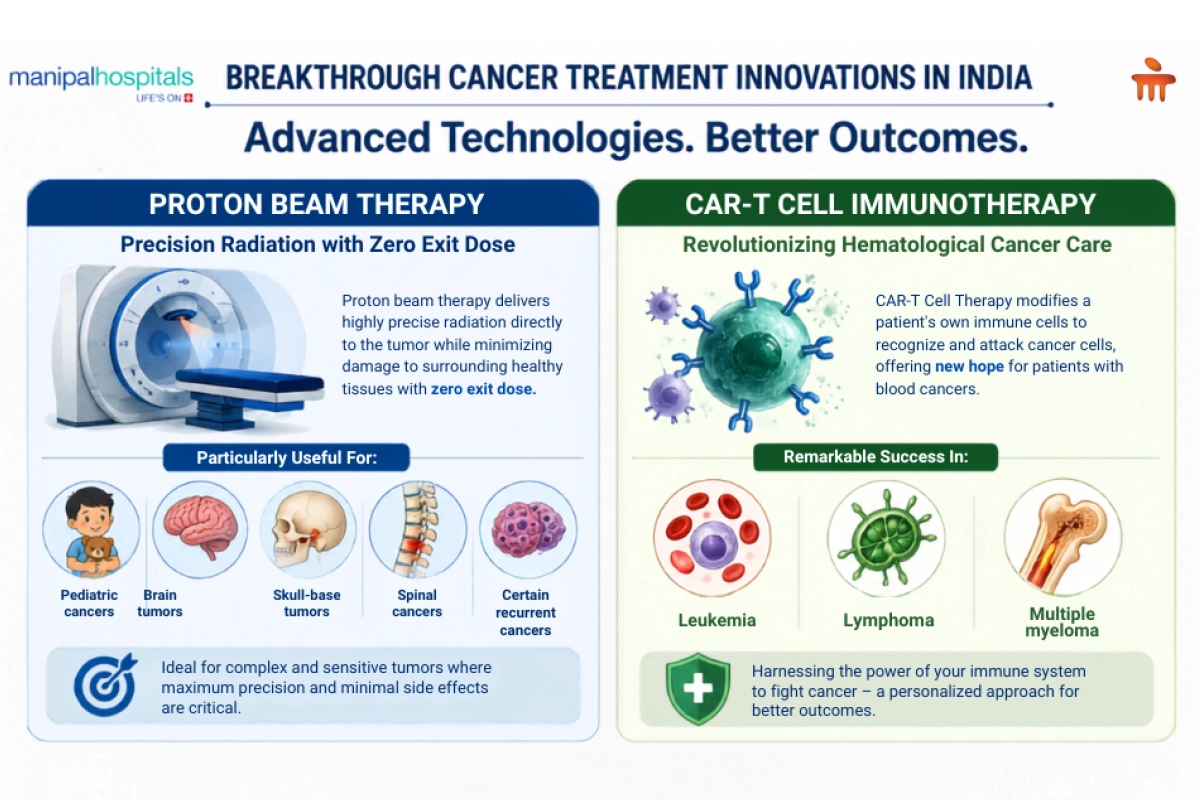
Chimeric antigen receptor T-cell therapy (CAR-T) represents a fundamentally different approach to cancer treatment. Rather than delivering a drug or radiation to the patient, CAR-T therapy engineers the patient's own immune cells to become cancer-killing agents.
The process involves extracting T-lymphocytes from the patient's blood, genetically reprogramming them in a laboratory to express a receptor targeting a specific protein on cancer cells, expanding them into hundreds of millions of engineered cells, and reinfusing them into the patient. These cells then hunt and destroy cancer cells expressing the target protein.
CAR-T has demonstrated remarkable results in blood cancer treatment in patients who have failed multiple prior lines of therapy and for whom conventional options are exhausted. Response rates in these populations that historically had poor prognoses have been transformative.
India became the first country in Asia outside of commercially licensed markets to develop and manufacture its own CAR-T cell therapy, NexCAR19, developed jointly by ImmunoACT and IIT Bombay and approved by the Central Drugs Standard Control Organisation (CDSCO) in 2023. This indigenous development has made CAR-T accessible in India at a cost that is approximately one-tenth of what the same therapy costs internationally.
Among India's large hospital networks, Manipal Hospitals Global occupies a distinctive position in the landscape of cancer care for international patients, particularly those from Bangladesh. With a presence across 50 hospitals and more than 10,000 beds spanning Bengaluru, Delhi, Kolkata, Goa, and other cities, Manipal offers the rare combination of network scale, clinical depth, and a consistently high standard of international patient services.
Manipal Comprehensive Cancer Centre operates across the network's flagship hospitals and is structured as an integrated, multidisciplinary oncology program, not a collection of individual specialists, but a coordinated tumor board model where surgical oncologists, medical oncologists, radiation oncologists, pathologists, and radiologists review each case together before a treatment plan is finalized. For Bangladeshi patients arriving with prior diagnoses, this multidisciplinary review frequently results in refined or revised treatment recommendations based on fresh imaging, molecular profiling, and specialist consensus.
Across the Manipal Hospitals network, patients can access:
Advanced Cancer Care Service | Description |
Robotic Surgical Oncology | Robotic surgical oncology using the da Vinci platform for procedures including robotic colectomy for colon cancer treatment, robotic-assisted lung resection for lung cancer treatment, robotic radical hysterectomy for cervical cancer treatment, and nipple-sparing mastectomy with reconstruction for breast cancer treatment. |
Precision Oncology & Molecular Profiling | Precision oncology and molecular profiling through next-generation sequencing, enabling targeted therapy matching for lung cancer treatment, breast cancer treatment, blood cancer treatment, and colorectal malignancies. |
Bone Marrow Transplantation Programs | Bone marrow transplantation programs for hematological cancers, including leukaemias, lymphomas, and myeloma, relevant to patients seeking blood cancer treatment of the highest standard. |
CAR-T Cell Therapy Access | CAR-T cell therapy access through network partnerships, for eligible patients with relapsed or refractory hematological malignancies. |
Immunotherapy & Clinical Trial Access | Immunotherapy and clinical trial access, with Manipal Hospital's research affiliations providing entry points to international trials for select patients. |
Manipal Hospitals Global, the network's dedicated international patient services division, provides end-to-end coordination for Bangladeshi families from the moment of first inquiry. Services include remote medical opinion before travel, document translation, visa facilitation letters, airport transfers, dedicated patient coordinators who speak Bengali and are familiar with Bangladeshi cultural and dietary needs, assistance with accommodation near hospital campuses, financial counseling and insurance support to help families plan treatment costs transparently.
For families seeking the best cancer treatment in India through a network that combines clinical breadth with structured international patient support, Manipal Hospitals Global is one of the most comprehensive options available to Bangladeshi patients. The network combines the advantages of advanced multispecialty hospitals with dedicated international patient teams who understand the unique medical, emotional, travel, and logistical concerns that Bangladeshi families often face during treatment journeys abroad.
Step 1 — Share Your Medical Reports
Send your medical reports, scans, prescriptions, or biopsy results through WhatsApp, email, or the international patient inquiry form.
Step 2 — Receive a Specialist Review and Treatment Plan
The medical team reviews your case and shares a personalised treatment opinion, estimated treatment plan, duration of stay, and approximate cost estimate.
Step 3 — Get Your Visa Invitation Letter and Travel Guidance
Once treatment is confirmed, the hospital provides the required medical visa invitation letter and supports patients with travel-related guidance.
Step 4 — Arrive in India with Dedicated International Patient Support
Dedicated coordinators assist with airport pickup guidance, hospital registration, language support, appointments, accommodation coordination, and treatment scheduling throughout your stay.
Contact Manipal Hospitals Global today to begin your treatment journey with confidence and clarity.

Not sure what you’re looking for?
Not sure what you’re looking for?
Get in touch with our representatives for
help!
Get in touch with our
representatives for help!