CAR T-Cell Therapy for Blood Cancer: How It Works, Benefits & Eligibility
Reviewed by: Cancer Care Department
Posted on Jul 22, 2026
9 Min Read
Synopsis
What is CAR T-Cell Therapy?
CAR T-cell therapy is a personalised form of targeted immunotherapy in which a patient's own T-cells are genetically modified in a laboratory to recognise and destroy specific cancer cells.
Our immune system relies on T-cells, a type of white blood cell, to identify and eliminate infections and abnormal cells. However, many cancer cells develop mechanisms that help them evade immune detection.
This therapy overcomes this challenge by engineering the patient's T-cells to express chimeric antigen receptors (CARs). These specially designed receptors enable the T-cells to recognise proteins found on cancer cells, allowing them to seek out and destroy the cancer more effectively.
Because the modified immune cells continue to function inside the body after infusion, this is often referred to as a "living drug".
Today, this therapy has become an important treatment option for selected patients with the following:
- Acute Lymphoblastic Leukaemia (ALL)
- Diffuse Large B-cell Lymphoma (DLBCL)
- Primary Mediastinal B-cell Lymphoma
- Mantle Cell Lymphoma
- Follicular Lymphoma
- Multiple Myeloma
- Other approved haematological malignancies depending on clinical indications
Research is also underway to evaluate CAR T-cell therapy for solid tumours.
How Does CAR T-Cell Therapy Work?
It involves collecting, modifying, multiplying, and reinfusing a patient's immune cells to attack cancer.
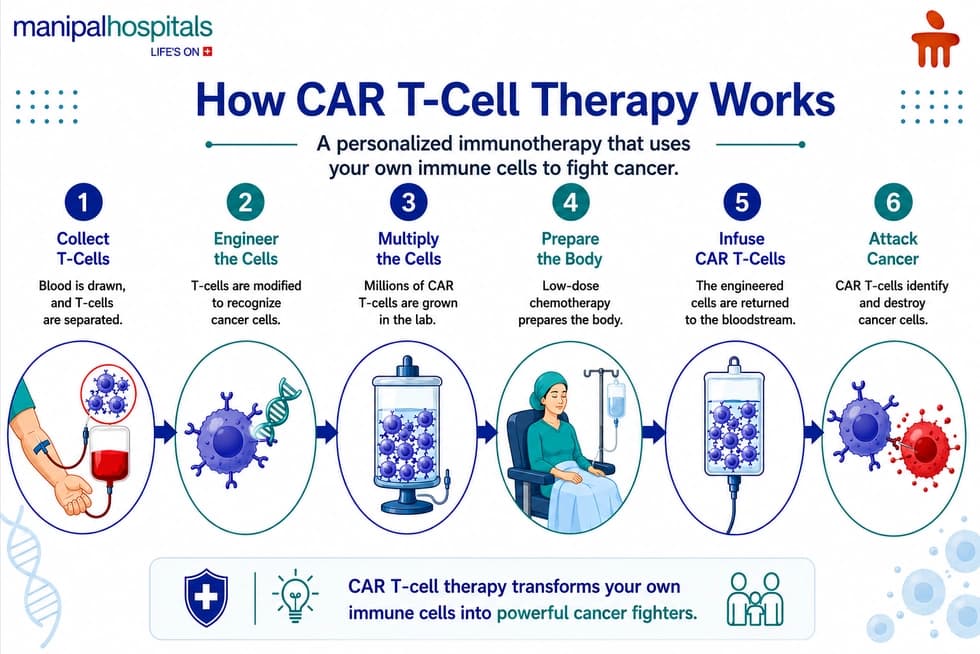
The treatment follows several carefully coordinated steps.
| Step | Treatment Phase | What Happens |
| 1 | Collection (Apheresis) | Blood is collected, and T-cells are separated from the remaining blood components. |
| 2 | Genetic Engineering | The T-cells are genetically modified in a specialised laboratory to produce chimeric antigen receptors (CARs). |
| 3 | Cell Expansion | The engineered CAR T-cells are multiplied into millions of powerful immune cells. |
| 4 | Conditioning Chemotherapy | Before infusion, patients receive low-dose chemotherapy to prepare the immune system for the modified cells. |
| 5 | CAR T-cell Infusion | The engineered cells are infused back into the bloodstream, where they begin identifying and attacking cancer cells. |
| 6 | Monitoring & Recovery | Patients are closely monitored for treatment response and potential side effects over several weeks. |
The entire process typically takes three to six weeks, although timelines vary depending on manufacturing schedules and the patient's clinical condition.
Benefits of CAR T-Cell Therapy for Blood Cancer Treatment
This therapy offers a highly targeted treatment option for eligible patients with blood cancers, particularly those whose disease has returned or failed to respond to previous therapies.
Some of its major advantages include:
Highly Personalised Treatment
Since the therapy uses the patient's own immune cells, it is uniquely tailored to each individual.
Precision Targeting
Unlike conventional chemotherapy, which affects both healthy and cancerous cells, CAR T-cells are engineered to recognise specific cancer-associated proteins.
Hope After Relapse
Patients whose cancers have relapsed after chemotherapy, stem cell transplantation, or targeted therapies may still benefit from it.
Potential for Durable Remission
Several clinical studies have demonstrated long-term remission in appropriately selected patients, even after multiple previous treatment failures.
One-Time Treatment
For many patients, CAR T-cell therapy is administered as a single infusion, although long-term follow-up remains essential.
A Breakthrough in Leukemia Treatment
It has significantly improved outcomes for certain patients with acute lymphoblastic leukaemia (ALL) and other B-cell malignancies.
Children and adults with relapsed or refractory B-cell ALL have demonstrated remarkable response rates following CAR T-cell therapy.
The therapy has also shown excellent clinical outcomes in several aggressive lymphomas and continues to expand into newer indications through ongoing clinical research.
For patients who previously had limited treatment options, this therapy has become one of the most important advances in modern leukaemia treatment.
Who is Eligible for CAR T-Cell Therapy?
It is recommended only for carefully selected patients following a comprehensive evaluation by an experienced oncology team.
Patients may be eligible if they:
- Have certain approved types of blood cancers
- Have relapsed after previous treatment
- Have cancer that has not responded to standard therapies (refractory disease)
- Are medically fit enough to tolerate treatment and monitoring
- Meet disease-specific eligibility criteria established by their oncology team
Eligibility also depends on factors such as:
- Age
- Overall health
- Organ function
- Previous treatments
- Cancer subtype
- Current disease burden
Not every patient with blood cancer qualifies for CAR T-cell therapy, making consultation with specialised haematologists and medical oncologists essential.
Understanding Blood Cancer Treatment Cost: Is CAR T-Cell Therapy Covered?
It is among the most advanced, and therefore most resource-intensive, forms of blood cancer treatment. This cost is driven by the highly individualised nature of the treatment, essentially creating a custom-manufactured drug for one specific patient. Additionally, the process requires specialised laboratory engineering, intensive care monitoring, and extended hospital stays.
Several factors contribute to the overall treatment cost:
- Personalised laboratory manufacturing
- Advanced biotechnology
- Specialised oncology expertise
- Hospital admission
- Intensive monitoring
- Management of treatment-related side effects
- Long-term follow-up care
Many international insurance providers, as well as specific medical travel networks, do offer coverage for this procedure given its life-saving potential. Patients travelling to Manipal Hospitals Global are encouraged to speak with our international patient care coordinators to navigate insurance approvals, financing options, and a transparent breakdown of treatment costs.
Potential Side Effects to Watch For
Like all advanced cancer treatments, it can cause side effects that require expert monitoring.
Fortunately, experienced cancer centres have established protocols for recognising and managing these complications early.
Cytokine Release Syndrome (CRS)
Cytokine Release Syndrome (CRS) is the most common side effect of CAR T-cell therapy.
Symptoms may include:
- Fever
- Low blood pressure
- Chills
- Fatigue
- Rapid heartbeat
- Difficulty breathing
Most cases are manageable with prompt medical intervention.
Neurological Side Effects
Some patients may experience temporary neurological symptoms, such as:
- Confusion
- Difficulty speaking
- Headache
- Tremors
- Seizures (rare)
These symptoms usually require close monitoring by experienced oncology teams.
Low Blood Counts
Temporary reductions in blood cell counts may increase the risk of:
- Infection
- Bleeding
- Fatigue
Patients undergo regular blood tests during recovery.
Why Choose Manipal Hospitals Global?
Cancer care requires more than advanced technology; it requires coordinated expertise, personalised treatment planning, and compassionate support throughout the patient journey.
At Manipal Hospitals Global, patients benefit from:
- Multidisciplinary cancer specialists
- Advanced haematology and oncology expertise
- Comprehensive diagnostic services
- Personalised treatment planning
- Dedicated international patient services
- Infection-controlled treatment environments
- Advanced intensive care support
- Long-term survivorship and follow-up programs
Our teams at Manipal Hospitals Global work collaboratively to determine whether CAR T-cell therapy is the right treatment option for each patient while ensuring comprehensive support before, during, and after treatment.
Final Thoughts
CAR T-cell therapy represents one of the most significant breakthroughs in modern cancer treatment. By harnessing the body's own immune system, it offers a personalised and highly targeted approach for patients with certain blood cancers, particularly when conventional therapies have not been successful.
Although the treatment is complex and requires careful patient selection, advances in immunotherapy continue to improve outcomes and expand access to this innovative option.
If you or a loved one has been diagnosed with leukaemia, lymphoma, multiple myeloma, or another eligible blood cancer, consulting an experienced oncology team is the first step toward understanding whether CAR T-cell treatment is an appropriate treatment option.
Consult the Experts at Manipal Hospitals Global
The multidisciplinary oncology specialists at Manipal Hospitals Global provide comprehensive evaluation, advanced cancer treatment, and personalised care for patients from around the world. If you would like to learn more about CAR T-cell therapy or explore your treatment options, schedule a consultation with our cancer experts today.
Share this Article


Not sure what you’re looking for?
Not sure what you’re looking for?
Get in touch with our representatives for
help!
Get in touch with our
representatives for help!