Finding an unexpected lump or being told you have a mass after a routine scan can be very upsetting. The word "tumour" carries significant weight, and it is completely natural to worry about what it means for your future. At its baseline, a tumour is just a collection of cells that have multiplied abnormally to form a distinct mass.
When a doctor discovers an abnormal growth, their primary goal is to find out its specific cell type and behaviour. This is where understanding the difference between a benign vs malignant tumour becomes important. While people often think of this distinction as a simple split between "safe" and "dangerous", the biological reality has a bit more detail. Understanding how these cell masses grow and behave can help you navigate a diagnosis with less anxiety. In this blog, you will learn about a benign tumour, what are the differences between malignant and benign tumours, and when a tumour might need closer attention. If you or someone you know has been diagnosed with a tumour, this blog will help you understand the terminology and what it means for your care.
To define a benign tumour, pathologists assess how the abnormal cells grow and interact with the surrounding tissues. These cells grow abnormally, but they do not possess the biological capability to invade adjacent structures or break off to travel to distant parts of the body. They remain entirely contained within their original site of development.
Characteristics of a Benign Tumour
When exploring what is a benign tumour, it helps to understand that these masses are non-cancerous. They typically grow at a slow pace. As the mass expands, it often develops a distinct, smooth border or a fibrous capsule that physically separates it from the surrounding healthy tissue.
Non-invasive or localised abnormal cells on the left remain strictly limited within the upper epithelium layer. They do not cross the protective basement membrane (boundary). However, a fully developed malignant tumour on the right side of the visual actively breaks through this basement membrane (boundary), infiltrating the deeper tissue layers known as the stroma. This clear structural distinction dictates how doctors approach treatment.
Common Types of Benign Tumours
Benign growths can appear almost anywhere in your body, and they are usually named after the specific tissue they come from:
Adenomas: These develop in the thin layer of tissue that covers glands and organs. You might hear about them if a doctor finds a polyp during a routine colon check.
Fibromas: Growths made of fibrous connective tissue. They can form anywhere, but they are very common in the uterus, where people usually call them fibroids.
Lipomas: Soft, doughy lumps of fat cells that grow just under the skin. They are common on the neck, back, or shoulders, and you can easily wiggle them with your finger.
Haemangiomas: A collection of extra blood vessels that build up under the skin or in internal organs. On the skin, they often look like red birthmarks and sometimes disappear on their own over time.
Papillomas: Growths that push outward from epithelial tissue, forming small, finger-like shapes.
Hamartomas: Organised but abnormal clusters of mature cells that match the organ they are in, often found in the lungs or liver.
Do Benign Tumours Require Treatment?
Because these growths do not spread, they often do not need immediate intervention. If a growth is small and not causing pain, a doctor might suggest active surveillance—which means leaving it alone but checking it regularly with ultrasound or X-ray scans to make sure it stays stable.
However, they are not always completely harmless. If a non-cancerous mass grows inside a tight space, it can cause problems by pressing on vital organs, blood vessels, or nerves. For example, a growth inside the skull can press against brain tissue, making surgery necessary even though the cells themselves are completely non-cancerous. Once a surgeon removes a benign growth, it rarely comes back.
Cellular Changes: Do Benign Tumours Become Cancerous?
Patients frequently ask their care team: do benign tumours become cancerous later in life? The majority of these growths remain non-cancerous. However, a few specific types do carry a risk of transforming if the cells pick up new genetic mutations.
Doctors watch these masses for two main signs of change:
Hyperplasia: This is when normal-looking cells begin to divide much faster than usual, meaning there are more cells than normal in that space. The tissue layout still looks normal, but the quick growth means it needs watching.
Dysplasia: This is a more advanced change where the new cells start to look physically distorted and abnormal under a microscope.
Dysplastic cells are often considered precancerous, and doctors usually prefer to remove them early before they can cause further issues.
What Is a Malignant Tumour?
A malignant growth is what we collectively refer to as cancer. These masses form when mutated cells divide uncontrollably, ignore the body's signals to stop, and actively push into the healthy tissues around them.
Malignant cells do not stay contained. They can break off from the original mass, enter your bloodstream or lymphatic system, and set up new growths in entirely different organs. This process of travelling and spreading is called metastasis. Because of this behaviour, treating a malignant growth early is vital to stop it from damaging multiple systems.
Common Malignant Varieties
Cancerous growths are grouped by the specific cells where the mutations started:
Carcinomas: This is the most frequent type of cancer. It starts in the epithelial cells that line the inside of your organs and make up your skin. Examples include basal cell carcinomas and adenocarcinomas.
Sarcomas: These develop in your connective tissues, such as your bones, muscles, cartilage, fat, and blood vessels.
Blastomas: Tumours that originate in developing embryonic tissue or precursor cells. They are more common in children and usually affect organs like the brain or retinas.
Understanding Brain and Cranial Tumours
Growths in the central nervous system behave a bit differently because the skull has no room to expand. When evaluating problems in the brain, doctors look closely at the specific types of malignant brain tumours, such as glioblastoma, astrocytomas, and medulloblastomas. These conditions form in the supportive glial cells of the brain and can spread through nervous tissue quickly.
Determining a malignant brain tumour prognosis involves evaluating several factors together:
The grade of the tumour (how aggressive the cells look).
Where the mass is located and whether a surgeon can reach it without damaging vital functions like speech or movement.
The patient’s age and overall physical stamina.
Specific genetic markers that show if the cells are vulnerable to targeted chemotherapy or radiation.
Treatment may involve tumour resection, chemotherapy, radiation therapy, targeted therapy, or stereotactic radiosurgery (SRS), depending on the tumour type, location, and overall health of the patient.
Benign vs Malignant Tumour: Key Differences
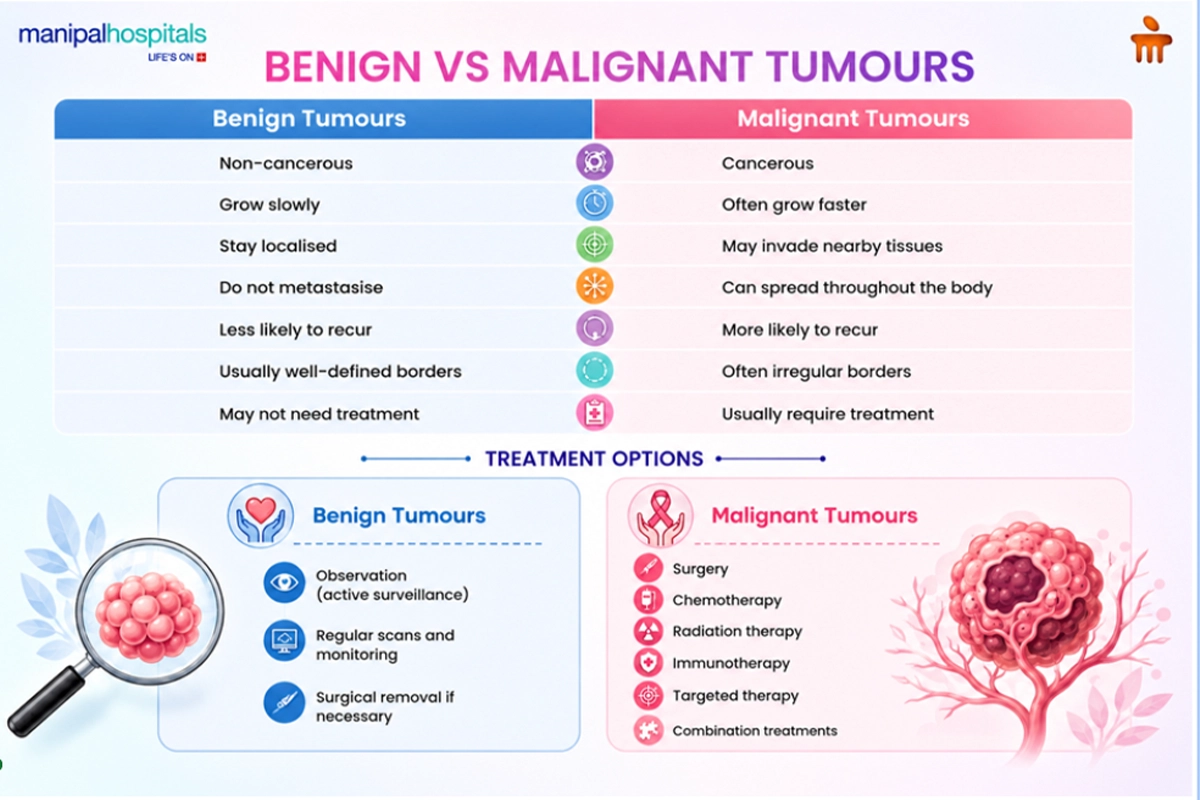
When diagnosing a patient, medical teams look at growth speeds, cell shapes, and how the mass interacts with boundaries. To answer what the differences are between malignant and benign tumours clearly, it helps to compare their traits side by side:
Feature
Benign Mass
Malignant Mass
Is it cancer?
No.
Yes.
Growth Speed
Generally slow, sometimes stops growing entirely.
Often fast and aggressive.
Invasion
Stays local; respects tissue boundaries.
Spreads into surrounding healthy tissue.
Spreading (Metastasis)
Incapable of travelling to other organs.
High risk of spreading through blood or lymph channels.
Physical Border
Usually smooth, even, and wrapped in a capsule.
Often irregular, jagged, and poorly defined.
Movement
Often shifts slightly when a doctor presses it.
Typically feels fixed or anchored in place.
Coming Back
Very unlikely to return once removed.
Higher chance of recurring after surgery.
This comparison highlights the key differences in a benign vs malignant tumour and explains why distinguishing between them is essential for choosing the most appropriate treatment approach.
Although certain features may raise suspicion, it is not possible to determine whether a tumour is benign or malignant based on appearance or symptoms alone. A medical evaluation is essential for an accurate diagnosis.
How Do You Know If a Tumour Is Cancerous?
While blood tests and advanced imaging scans give doctors an idea of what a mass looks like, they cannot provide a definitive answer on their own. The only definitive way to know if a growth is cancerous is through a tissue biopsy. During this procedure, a specialist removes a small sample of cells from the mass using a thin needle or a minor incision. This sample goes to a laboratory where a pathologist examines the individual cells under a microscope. They check the internal cell structure, how fast the cells are dividing, and whether they are breaking through tissue walls, giving your care team the exact information needed to plan your next steps.
Based on the biopsy results and imaging findings, your specialist may recommend surgery, chemotherapy, targeted therapy, immunotherapy, or precision radiation therapies such as IMRT or IGRT, depending on the tumour type, stage, and overall health of the patient.
Why Choose Manipal Hospitals Global for Tumour Diagnosis and Treatment?
An accurate diagnosis is the first step towards effective treatment. At Manipal Hospitals Global, our multidisciplinary teams combine advanced diagnostic technology with personalised treatment plans to evaluate and manage both benign and malignant tumours.
Our comprehensive tumour care includes:
Advanced diagnostic services, including PET-CT, MRI, CT imaging, tissue biopsy, and specialised pathology evaluations for accurate diagnosis.
Expert multidisciplinary care from oncologists, surgeons, radiologists, pathologists, neurosurgeons, and other specialists working together to develop personalised treatment plans.
Comprehensive treatment options, including tumour resection, robotic-assisted cancer surgeries, chemotherapy, targeted therapy, immunotherapy, precision radiation therapies such as IMRT and IGRT, and palliative care, depending on the tumour type and stage.
Specialised care for complex tumours, including brain tumours and other cancers requiring highly coordinated treatment.
Dedicated international patient services, offering virtual consultations, personalised treatment planning, visa assistance, travel coordination, interpreter services, and seamless support throughout the treatment journey.
Whether you require further evaluation of a newly diagnosed tumour, a second opinion, or comprehensive cancer treatment, Manipal Hospitals Global provides expert, patient-centred care supported by advanced technology and experienced multidisciplinary teams.
Conclusion
A tumour diagnosis is always a significant moment, but getting clear facts about the cell structure is the most important part of finding a solution. Whether a mass is benign and simply needs monitoring or malignant and requires immediate treatment, modern diagnostics ensure that care plans are tailored to your exact biological needs. Manipal Hospitals Global offers advanced cancer care and diagnostic services and personalised treatment pathways for both benign and malignant tumours. Our multidisciplinary teams provide precise evaluations, expert care, and ongoing support tailored to each patient's needs.