
Why Is My Period Irregular? 7 Possible Causes and When to See a Gynaecologist
Reviewed by: Obstetrics and Gynaecology Department
Posted on Oct 19, 2026
10 Min Read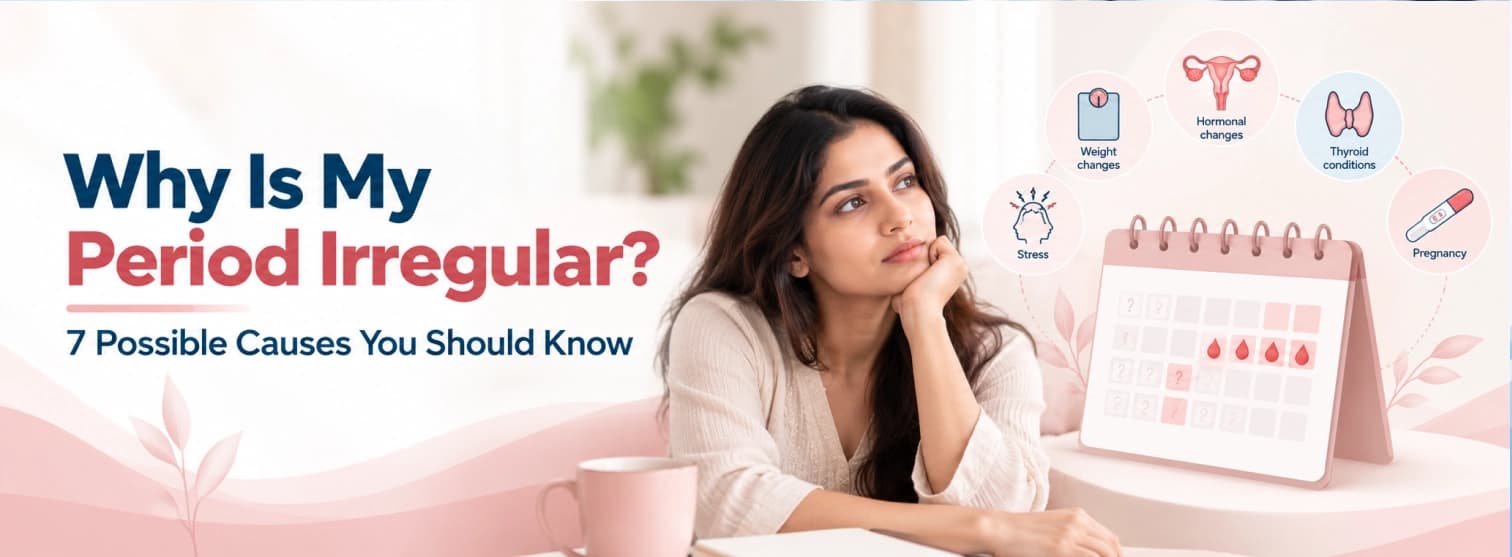
Synopsis
Understanding a Regular vs Irregular Cycle
The menstrual cycle is counted from the first day of one period to the first day of the next. Cycle length and bleeding patterns can vary between individuals, and the expected pattern also changes with age and reproductive stage.
What is considered an irregular period?
A menstrual cycle does not have to be exactly the same length every month to be considered regular. Some variation is normal. An irregular period is more likely when the gap between periods varies significantly, periods repeatedly occur unusually close together or far apart, or periods are missed. For many adults, menstrual cycles shorter than 21 days or longer than 35 days are considered irregular. Expected cycle lengths differ in teenagers and can change during the transition towards menopause.
The expected pattern also depends on age and stage of reproductive development. Menstrual cycles can be less predictable during the first few years after periods begin and may also change during the transition towards menopause.
The amount and duration of bleeding matter too. Bleeding that is consistently much heavier, lasts longer than usual, or occurs between periods should be assessed, particularly if it represents a change from your usual pattern.
There is no single pattern that defines every case of menstrual cycle irregularities. The timing and nature of the change matter.
Are irregular periods normal?
For teenagers, some irregularity is common in the first few years after periods begin. The menstrual cycle is still settling during this stage, so it may not follow a predictable pattern straight away.
An occasional change can happen at other times too. But if your periods remain irregular, become markedly different from your usual cycle, or the bleeding pattern changes significantly, it should not simply be put down to a normal variation.
Pattern | What it may look like |
Regular cycle | Periods occur in a fairly predictable pattern |
Irregular cycle | The time between periods varies considerably |
Missed period | A period does not occur when expected |
Heavy or prolonged bleeding | Bleeding is much heavier or lasts longer than usual |
So, what is an irregular period? It is less about one unusual month and more about a menstrual pattern that has become noticeably different or remains outside the usual range.
Causes of Irregular Periods
The timing of a period can change for many reasons. Let’s look at some of the common causes for irregular periods in women:
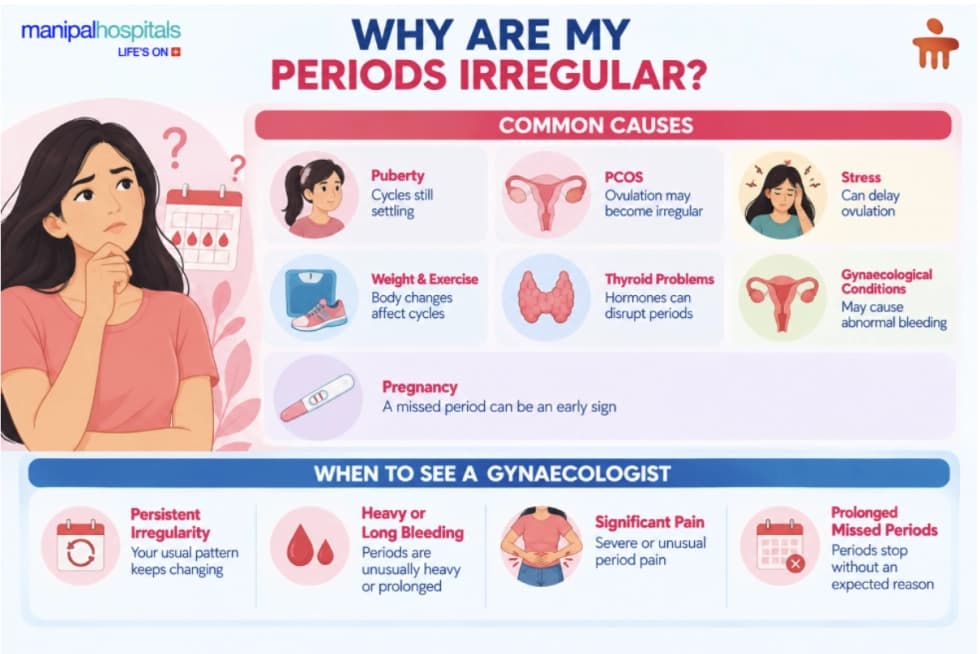
1. Puberty and the Early Teenage Years
The first few years after a girl gets her period can be unpredictable. Her menstrual cycle is still being established, and the hormonal signals that control it may not yet follow a steady pattern. A period may come after a shorter gap one month and a longer gap the next.
Parents often wonder how irregular periods in teenage girls can be managed. It’s important to understand that it does not always mean that something needs to be treated. Some irregularity is expected during puberty. But if periods remain very irregular, or bleeding becomes heavy or lasts unusually long, it should be assessed.
2. PMOS (Formerly Known as PCOS)
PMOS, formerly known as polycystic ovary syndrome (PCOS), can affect ovulation and cause irregular or absent periods. As a result, periods may become irregular, with longer gaps between them, or they may stop for a period of time. The hormonal changes associated with PMOS can also contribute to acne and increased facial or body hair. Some people may also experience weight changes.
These changes do not mean that everyone with irregular periods has PMOS. There are several possible causes, and PMOS is one of them, particularly when irregular or absent periods occur alongside other associated symptoms. The menstrual pattern and other symptoms need to be considered together.
3. Stress
Stress can affect the hormones involved in menstruation and may change the timing of ovulation. This can make periods come later than usual, become irregular, or stop for a while. Changes in the body can have a similar effect. Significant weight loss or gain, very low body fat, and intense physical activity have all been linked with changes in the menstrual cycle. The effect is not always immediate, and the change may show up as a shift in the usual pattern of periods.
4. Exercise and Diet
A big change in body weight can affect the menstrual cycle. Hormones needed for regular ovulation can be affected by significant weight loss, very low body fat or inadequate nutrition. The same thing can happen during strenuous exercise, especially if the body does not have enough energy to keep normal functions.
Such changes can cause periods to become lighter, irregular, or stop altogether. Thus, the menstrual cycle can be indicative of changes in the energy balance of the body and not just of changes within the reproductive system itself.
5. Thyroid and Other Hormonal Conditions
The thyroid gland also helps to regulate the menstrual cycle. If the thyroid is not working properly, hormonal changes can impact ovulation and change the timing of periods. They can be irregular, heavier, lighter or less frequent.
Other hormonal problems can affect the cycle in a similar way. Hormones that regulate menstruation can get out of balance, and ovulation may not happen on a regular basis. It can alter the normal spacing between periods. Sometimes periods stop for a while.
6. Endometriosis and Other Gynaecological Conditions
Does endometriosis cause irregular periods? Endometriosis can be associated with painful, heavy or irregular periods. However, irregular periods alone do not establish that someone has endometriosis. If changes in your bleeding occur alongside severe pelvic pain, painful periods, or pain during sex, a gynaecological assessment may be appropriate.
Other conditions affecting the uterus can also change menstrual bleeding. Uterine polyps and adenomyosis, for example, may be associated with abnormal or heavy bleeding. The exact pattern depends on the condition and the person.
7. Pregnancy and other medical reasons
If you’re sexually active, one of the first things to consider when a period doesn’t arrive when you expect it is pregnancy. A missed period can be an early sign of pregnancy, but there are other reasons for it to happen, too.
So can you get pregnant with irregular periods? Yes. Irregular cycles don’t mean you won’t get pregnant. The problem is ovulation may not occur at a predictable time, and thus it can be more difficult to pinpoint the fertile window.
Other medical causes include premature ovarian insufficiency and certain medications. Both can affect the normal menstrual pattern.
Can Irregular Periods Affect Fertility?
Irregular periods do not automatically mean infertility. However, they can sometimes indicate that ovulation is not happening regularly. Conditions such as PMOS (formerly known as PCOS), thyroid disorders, significant weight changes or other hormonal problems can affect ovulation and make conception more difficult.
If you are trying to conceive and your periods are consistently irregular, a gynaecologist can assess your menstrual pattern, ovulation, and possible underlying causes.
How Can You Track Ovulation With Irregular Periods?
Tracking ovulation can be more difficult when cycles are irregular because the fertile window may shift from one cycle to another. Some people use ovulation predictor kits, cervical mucus changes, or basal body temperature tracking. If your cycles are very irregular, these methods may be less predictable, and a gynaecologist can advise whether additional assessment is appropriate.
How Are Irregular Periods Treated?
There is no single treatment for irregular periods because management depends on the cause. A doctor may recommend lifestyle changes when stress, nutrition, weight changes, or excessive exercise are contributing factors. Conditions such as PMOS (formerly known as PCOS) or thyroid disorders may need specific treatment. Hormonal medicines may also be used in some cases to regulate bleeding or manage symptoms.
When Should You See a Gynaecologist for Irregular Periods?
If the irregular pattern continues or the bleeding changes significantly, it is worth getting it checked. Speak to a gynaecologist if:
- Your periods have become consistently irregular or the pattern is very different from before.
- The bleeding is very heavy or lasts longer than usual.
- You have significant pain during your periods.
- Your periods stop for a prolonged period without an expected reason.
- Irregular periods occur along with other symptoms that may suggest a hormonal or gynaecological problem.
Conclusion
Irregular periods can happen for different reasons. For some, it is part of the hormonal changes that occur during adolescence. For others, conditions such as PMOS (formerly known as PCOS) or other health problems may be involved. What matters is a clear change from your usual cycle, especially when it continues or becomes difficult to manage. If your periods remain irregular or the pattern concerns you, consult a gynaecologist at Manipal Hospitals Global for an appropriate evaluation.
Share this Article


Not sure what you’re looking for?
Not sure what you’re looking for?
Get in touch with our representatives for
help!
Get in touch with our
representatives for help!



