Congenital Heart Defects in Newborns: Symptoms, Surgery and Survival Rates
Reviewed by: Paediatric Department
Loading...

98, HAL Old Airport Road, Kodihalli, Bengaluru, Karnataka 560017
Accreditations


Copyright © 2025 Manipal Hospitals - All Rights Reserved
Reviewed by: Paediatric Department
Posted on Jun 24, 2026
12 Min Read
A congenital heart defect is a structural variation in the heart's walls, chambers, valves, or primary blood vessels that develops before birth. In a typical four-chambered heart, the right side pumps oxygen-poor blood to the lungs to gather oxygen, while the left side pumps this fresh blood through the body's main artery, the aorta, to supply your organs and limbs. Specialised valves ensure blood moves smoothly in a single direction. A structural defect happens during the first six weeks of pregnancy when these walls or vessels are forming, resulting in a variation that can disrupt normal blood routing.
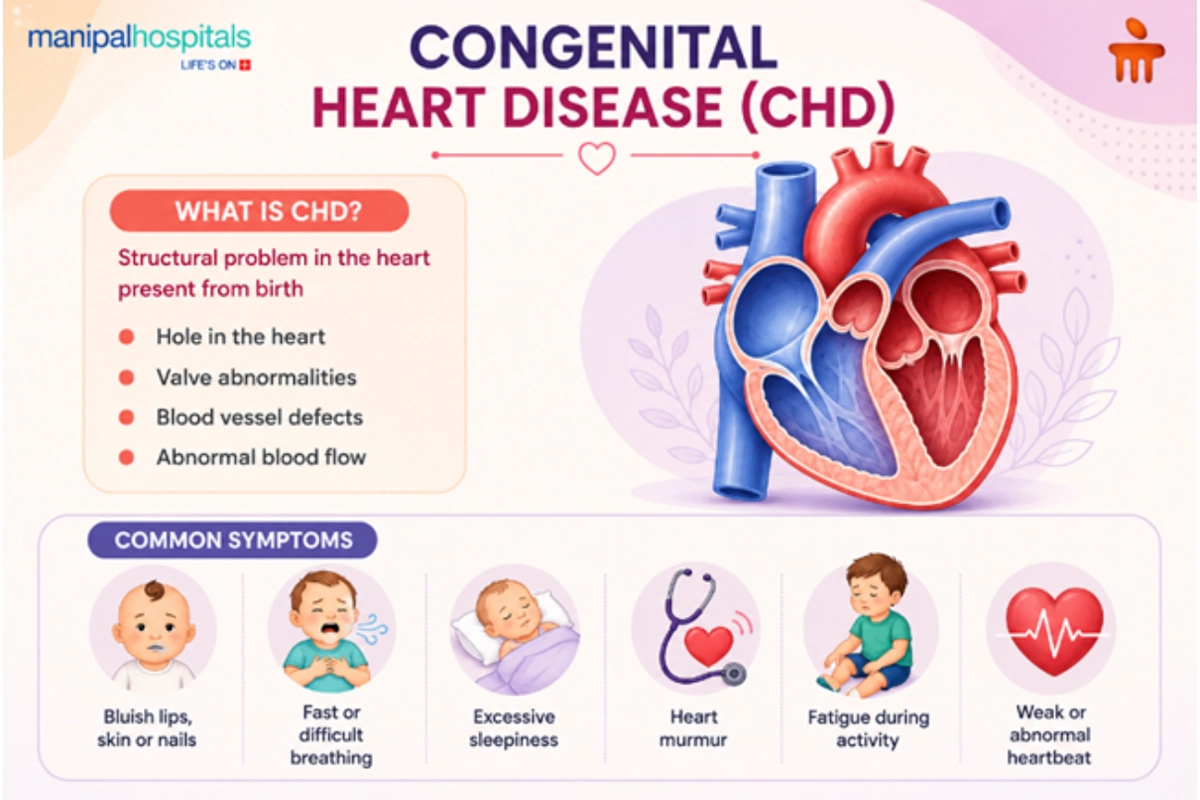
Some may be mild variations, but one group of conditions needs to be addressed urgently in the first few days or weeks of a baby’s life to protect their circulation. If you want to know the 7 critical congenital heart defects classified by paediatric cardiologists, they are:
Apart from the critical cases, many infants are born with simpler variations, which are normally classified into two types:
The most common type of variation is an abnormal opening in the tissue walls that separate the left and right sides of the heart, called a congenital septal defect heart:
Other children have narrow valves at birth that slow blood flow. This condition includes narrowing of the valve leading to the body (aortic stenosis) and narrowing of the valve leading to the lungs (pulmonary stenosis).
Mild heart defects may not cause any visible symptoms during infancy and are often picked up later in childhood during routine physicals. However, serious structural variations present distinct indicators during a baby's first few weeks of life.
Paying attention to congenital heart defects in newborns' symptoms allows parents and nurses to seek timely care. Watch out for these physical signs:
When looking into what causes congenital heart defects, it is important to know that in most cases, a defect is not driven by any single mistake or action taken by the parents. Most anomalies happen due to spontaneous genetic variations during early foetal cell division. However, clinical research has identified several risk factors that can increase the likelihood of a structural variation forming:
Many congenital heart defects can be detected during pregnancy through routine prenatal ultrasound examinations. If doctors identify a possible abnormality in the developing heart, they may recommend a foetal echocardiogram, a specialised ultrasound that provides detailed images of the baby's heart structure and blood flow.
Early diagnosis allows families and healthcare teams to plan delivery, arrange specialist cardiac care, and prepare for any treatment that may be needed shortly after birth. Prenatal detection can significantly improve outcomes for babies born with complex congenital heart defects.
Specialists use quick, non-invasive tests to evaluate how your baby's heart is structured and check its pumping efficiency. To address how a congenital heart defect is diagnosed comprehensively, doctors follow a targeted screening process:
Congenital heart defects require specialised evaluation, precise diagnosis, and timely intervention to ensure the best possible outcomes for children. At Manipal Hospitals Global, comprehensive congenital heart care is delivered through a multidisciplinary team of paediatric cardiologists, paediatric cardiac surgeons, neonatologists, cardiac anaesthesiologists, intensivists, and rehabilitation specialists who work together to create personalised treatment plans for every child.
Our advanced diagnostic capabilities include foetal echocardiography, neonatal echocardiography, paediatric cardiac MRI, CT angiography, pulse oximetry screening, and specialised cardiac imaging that enable accurate diagnosis before birth and throughout childhood. Early detection allows families and clinicians to make informed decisions and plan interventions at the most appropriate stage.
For children requiring treatment, Manipal Hospitals Global offers a full spectrum of congenital heart defect management, ranging from medical monitoring and minimally invasive catheter-based procedures to complex paediatric cardiac surgeries. Many structural heart defects can now be corrected using advanced interventional techniques that reduce hospital stay and support faster recovery, while complex congenital conditions benefit from highly specialised surgical expertise and dedicated paediatric intensive care support.
Recognising that congenital heart conditions often require long-term follow-up, our care extends beyond surgery to include developmental monitoring, nutritional guidance, cardiac rehabilitation, and lifelong transition care when required. International patients and families travelling to India also receive end-to-end support through dedicated international patient services, including virtual consultations, treatment planning, visa assistance, travel coordination, accommodation support, interpreter services, and post-treatment follow-up.
With advances in paediatric cardiac medicine and surgery, the majority of children born with congenital heart defects can now lead active, healthy, and productive lives. Early diagnosis and access to specialised cardiac care remain the foundation for achieving these positive outcomes.
Once the medical team maps the precise structural layout of the condition, they will build a customised plan for congenital heart defect treatments. Minor holes often simply require active monitoring, as many small septal defects close completely on their own as the child grows.
For more complex issues, modern management offers two main surgical paths:
The long-term outlook for children born with a CHD congenital heart defect has shifted dramatically over the last few decades. Historically, medical limitations meant that only about 10% of children with complex heart conditions survived into adult life. Today, thanks to remarkable leaps in early diagnosis, infant anaesthesia, and targeted surgical techniques, the prognosis has turned completely around. Over 90% of children diagnosed with a structural defect now survive safely into adulthood.
Discovering a structural heart variation in your newborn is a significant emotional moment, but it is a condition that often responds well to timely diagnosis and specialised care. By attending regular prenatal check-ups, ensuring newborn screening is completed, and seeking prompt evaluation when concerns arise, parents can help support their baby's healthy growth and development. At Manipal Hospitals Global, our multidisciplinary paediatric cardiology and neonatology teams provide advanced diagnostic services, specialised treatment options, and ongoing family-centred support to help children with congenital heart defects achieve the best possible outcomes. With early intervention and expert care, many children go on to lead active, healthy lives.

Not sure what you’re looking for?
Not sure what you’re looking for?
Get in touch with our representatives for
help!
Get in touch with our
representatives for help!