Advanced Spine Treatment for Mauritian Patients: Procedures, Recovery & International Patient Support
Reviewed by: Spine Care MIRSS Department
Posted on May 29, 2026
15 Min Read

Loading...

98, HAL Old Airport Road, Kodihalli, Bengaluru, Karnataka 560017
Accreditations


Copyright © 2025 Manipal Hospitals - All Rights Reserved
Reviewed by: Spine Care MIRSS Department
Posted on May 29, 2026
15 Min ReadThere is a particular kind of suffering that comes with a damaged spine, and if you are reading this, you likely know it well. It often begins quietly: a dull ache in the lower back after a long day, a stiffness in the neck that never quite resolves, a discomfort that gradually becomes part of everyday life. Then, over time, it can evolve into something far more disruptive. A sharp, electric pain shooting down the leg. Numbness in the foot that makes walking uncertain. Tingling in the hands. Weakness in an arm or leg that was not there before.
Back pain, neck pain, numbness, tingling, and weakness can make even simple daily activities difficult. These symptoms are often caused by conditions such as herniated discs, spinal stenosis, degenerative disc disease, and nerve compression. For many Mauritians, the challenge is not simply managing pain but finding effective, lasting treatment that restores mobility, independence, and quality of life.
Modern spine care has advanced significantly over the past decade. Today, patients have access to sophisticated diagnostic tools, minimally invasive procedures, advanced surgical techniques, comprehensive rehabilitation programmes, and multidisciplinary teams dedicated to treating complex spinal conditions.
This guide is designed for Mauritian patients and their families seeking clarity about advanced spine treatment options. It explores common spinal conditions, available treatment approaches, recovery expectations, and how to access specialised spine care at Manipal Hospitals Global.
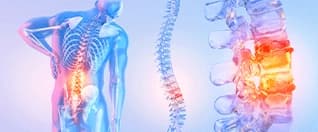
A slipped disc occurs when the inner disc material pushes through the outer layer and compresses nearby nerves.
Between each pair of vertebrae sits an intervertebral disc, a shock-absorbing cushion that allows flexibility while maintaining the spacing needed to keep spinal nerves free from compression. Each disc consists of:
A herniated disc, also known as a slipped disc, prolapsed disc, or ruptured disc, occurs when the soft inner material pushes through a tear or weakness in the outer layer. If the displaced disc material compresses a nearby nerve root, pain and neurological symptoms can develop.
Symptoms vary depending on the location and severity of nerve compression. Common signs include:
Many patients notice symptoms gradually worsen over time, while others experience sudden onset after lifting, twisting, or an injury.
In many cases, yes.
Mild to moderate disc herniations can improve over weeks or months with conservative treatment. The body's natural healing mechanisms may gradually reduce inflammation and even reabsorb portions of the herniated disc material.
Common non-surgical treatments include:
Patients who respond well to these measures may avoid surgery altogether while still achieving meaningful pain relief and functional recovery.
Unfortunately, not every herniated disc improves on its own.
Conservative treatment may be reaching its limits when:
At this stage, the focus shifts from simply controlling symptoms to restoring function and preventing long-term nerve damage.
Advanced spine care may be recommended when non-surgical options no longer provide adequate relief or when the condition is progressing.
Depending on the diagnosis, treatment options may include:
Modern spine surgery aims not only to relieve pain but also to preserve mobility, accelerate recovery, and improve long-term spinal health.
You should seek specialist evaluation if you experience:
Early specialist assessment can help determine whether continued conservative care, minimally invasive treatment, or surgical intervention is the most appropriate next step.
If you have already exhausted conservative treatment, or if your condition is progressing, understanding the full range of modern spine care options becomes essential.
Modern spine surgery has evolved significantly over the past two decades. For appropriately selected patients, minimally invasive spine surgery (MISS) offers greater precision, reduced tissue disruption, and faster recovery compared to conventional open techniques.
The principle behind MISS is tissue preservation. Instead of cutting through large muscle groups, surgeons use specialised tubular retractors to create a small pathway to the spine while minimising damage to surrounding tissues. This approach typically results in less blood loss, lower infection risk, reduced post-operative pain, and shorter recovery times.
The following are some of the advanced spine procedures available at India's leading spine centres.
For patients whose primary problem is herniated disc sciatica, the nerve pain caused by a herniated disc pressing against a spinal nerve root, microdiscectomy is the most established and most consistently effective surgical intervention available.
The procedure is performed under general anaesthesia through an incision of approximately 2 to 3 centimetres. Using a high-definition operating microscope that magnifies the surgical field, the surgeon removes the herniated disc fragment that is compressing the nerve, along with any additional material at risk of re-herniation. The nerve root is carefully decompressed, and the incision is closed. The entire procedure typically takes 45 to 90 minutes.
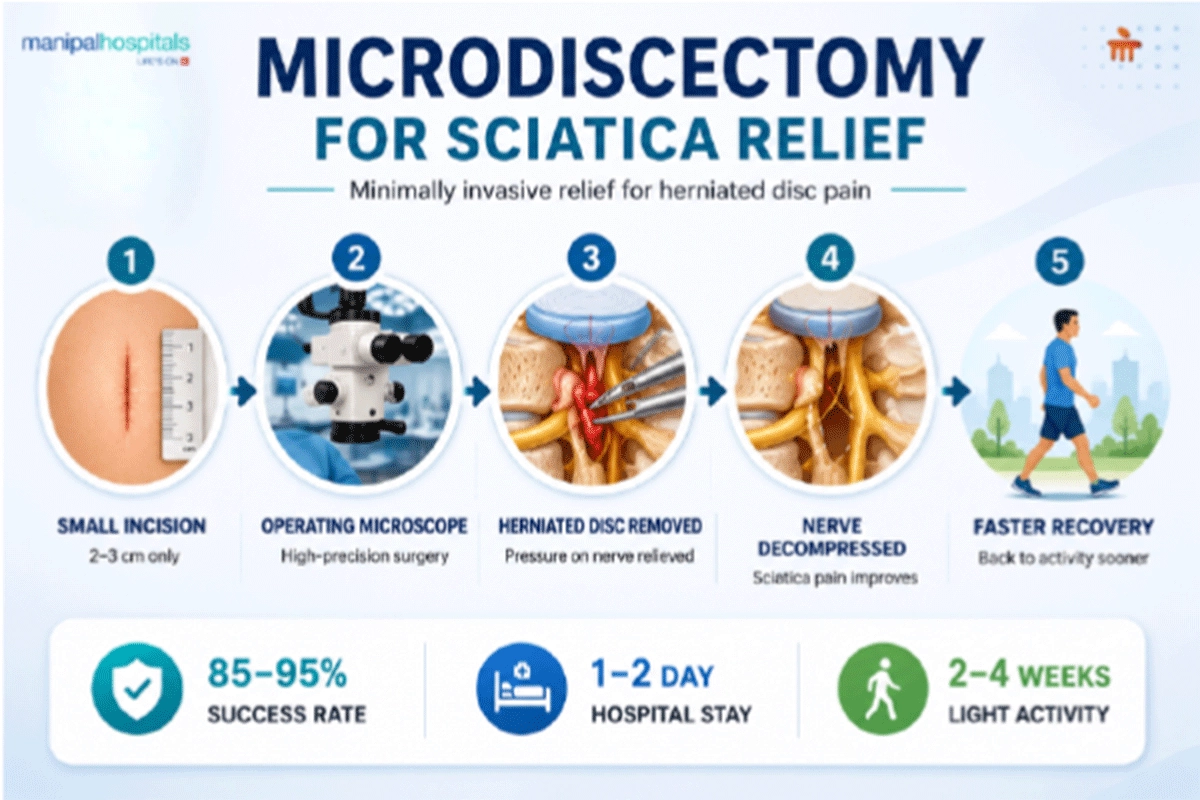
Microdiscectomy has one of the highest success rates in spine surgery, with 85-95% of patients experiencing significant relief from nerve-related leg or arm pain. Many notice improvement within days of surgery. Most patients stay in the hospital for one to two days, return to light activities within two to four weeks, and resume normal activities within six to eight weeks.
The procedure is typically recommended for patients whose symptoms persist despite six weeks of conservative treatment or who develop progressive neurological weakness, such as foot drop.
Endoscopic microdiscectomy, which uses even smaller incisions and a fibre-optic endoscope, offers similar outcomes and may allow selected patients to be discharged the same day or the following day.
For patients with significant disc degeneration, particularly in the cervical spine (neck), Artificial Disc Replacement (ADR) offers a motion-preserving alternative to traditional spinal fusion.
In spinal fusion, the damaged disc is removed and the adjacent vertebrae are permanently joined together. While effective in relieving symptoms, fusion eliminates movement at that spinal level and may increase stress on neighbouring discs over time.
ADR replaces the damaged disc with a specially designed prosthesis that maintains disc height, absorbs shock, and preserves natural spinal motion. By retaining movement at the treated level, ADR may reduce stress on adjacent segments and lower the long-term risk of further degeneration.
ADR is best suited for carefully selected patients with one- or two-level disease, without significant spinal instability or advanced facet joint arthritis. When appropriate, ADR can offer faster recovery, greater preservation of neck mobility, and a reduced likelihood of requiring future surgery compared to fusion.
For patients with spinal instability, degenerative spondylolisthesis, recurrent disc herniation, or abnormal vertebral movement, spinal fusion may be the most effective treatment option. Today, many of these procedures can be performed using minimally invasive techniques.
MISS TLIF (Transforaminal Lumbar Interbody Fusion) and MISS PLIF (Posterior Lumbar Interbody Fusion) achieve the same goals as traditional fusion, removing the damaged disc, restoring spinal alignment, and creating a stable bony fusion, but through much smaller incisions.
Using specialised tubular retractors, surgeons access the spine with minimal disruption to surrounding muscles. The damaged disc is removed, an interbody cage containing bone graft material is inserted to restore disc height, and titanium screws are placed to stabilize the spine.
Compared to conventional open surgery, minimally invasive fusion is associated with less blood loss, reduced post-operative pain, lower infection risk, shorter hospital stays, and faster recovery while delivering comparable long-term fusion outcomes.
One of the most significant advances in modern spine surgery is the integration of robotic assistance and computer-assisted navigation systems.
These technologies provide surgeons with real-time three-dimensional visualisation of the spine and highly precise guidance for implant placement. During complex spinal fusion and stabilisation procedures, robotic navigation can improve surgical accuracy, minimise tissue disruption, and reduce the risk of implant malposition.
For patients, this often translates into smaller incisions, improved safety, reduced radiation exposure, and enhanced surgical precision.
Spinal stenosis occurs when narrowing of the spinal canal compresses the spinal cord or nerve roots. It is particularly common among older adults and can cause back pain, leg pain, numbness, weakness, and difficulty walking.
Advanced decompression procedures are designed to relieve pressure on neural structures while preserving as much normal anatomy as possible.
Depending on the severity and location of compression, treatment options may include:
Many patients experience substantial improvement in walking tolerance, mobility, and quality of life following successful decompression surgery.
Not all spinal conditions affect the lower back. Disorders involving the cervical spine can lead to neck pain, arm pain, hand numbness, muscle weakness, and, in severe cases, spinal cord compression.
Advanced cervical spine procedures may include:
The primary goals are to relieve nerve compression, preserve neurological function, and restore spinal stability while maintaining the greatest possible range of motion.
Some patients seek treatment after previous spine surgery has failed to deliver lasting relief or when new problems develop over time.
Revision spine surgery may be considered for:
These procedures are often technically complex and require specialised expertise, advanced imaging review, and meticulous surgical planning to achieve optimal outcomes.
Historically, spinal fusion was the standard solution for many degenerative spine conditions. While fusion remains highly effective when appropriately indicated, modern spine surgery increasingly emphasises motion preservation whenever possible.
Examples include:
By maintaining natural spinal movement, these techniques may reduce stress on adjacent spinal segments and support long-term spinal function in carefully selected patients.
Certain spinal conditions require advanced stabilisation to restore alignment, protect neurological structures, and improve mechanical function.
These conditions may include:
Modern stabilisation techniques utilise advanced implants, image-guided placement systems, biologics, and minimally invasive approaches whenever appropriate to improve outcomes and facilitate recovery.
The clinical advantages are significant: reduced blood loss (often eliminating the need for transfusion), dramatically lower post-operative pain, reduced infection risk, shorter hospital stay (typically three to five days versus seven to ten days for open fusion), and faster functional recovery. Patients who undergo MISS fusion typically achieve solid bony union equivalent to open arthrodesis, with substantially less disruption to the body's recovery reserves.
Surgery corrects the underlying spinal problem, but recovery depends on more than the procedure itself. Rehabilitation is essential for rebuilding strength, restoring mobility, and helping patients safely return to daily activities after they return to Mauritius.
1. Weeks 1-4: Early Recovery
2. Weeks 4-12: Strengthening Phase
3. 3-6 Months: Functional Recovery
Recovery varies depending on the procedure performed, the patient's overall health, and adherence to rehabilitation recommendations. The following timelines provide a general guide for commonly performed spine procedures.
Procedure | Early Mobility | Return to Light Activities | Return to Work | Typical Full Recovery |
Microdiscectomy | Walking within 24 hours | 1-2 weeks | 2-4 weeks (office work) | Around 3 months |
Endoscopic Spine Surgery | Same day or next day walking | Within 1 week | 1-3 weeks | 6-12 weeks |
Artificial Disc Replacement (ADR) | Walking the next day | 2-4 weeks | 2-6 weeks | 3-4 months |
MISS TLIF / MISS PLIF Fusion | Walking with assistance in 24-48 hours | 4-6 weeks | 6-12 weeks depending on job demands | 3-6 months, depending on fusion progress |
Structured physiotherapy is an essential part of recovery. Rehabilitation helps:
Most patients continue rehabilitation with a local physiotherapist after returning home.
Before travelling home, patients should obtain:
Sharing this plan with a Mauritian physiotherapist within the first two weeks after returning home helps ensure continuity of care.
Modern spine care does not end at hospital discharge. Virtual follow-up consultations allow patients to remain connected with their surgical team after returning to Mauritius.
Telemedicine appointments can help with:
This ongoing support helps maintain continuity of care throughout the recovery journey.
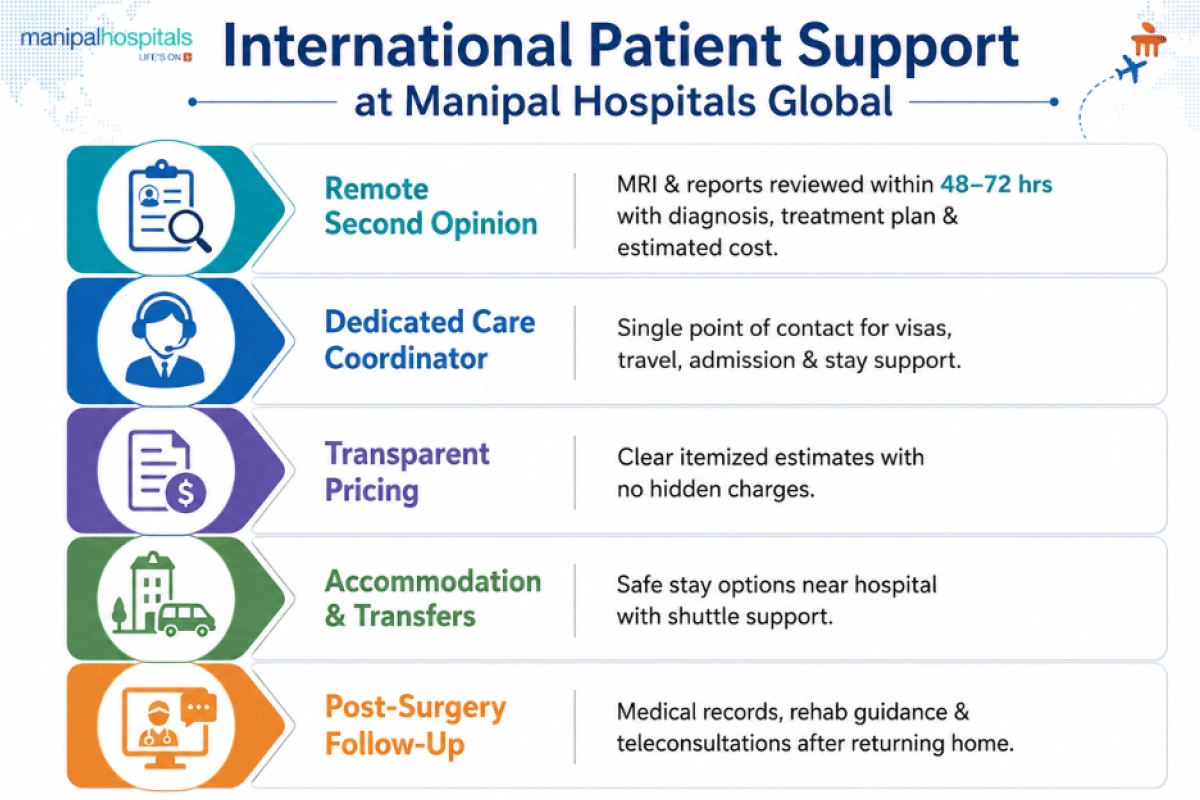
Manipal Hospitals Global offers seamless end-to-end support for Mauritian patients seeking advanced spine treatment in India, from expert second opinions before travel to continued care after returning home.
With dedicated coordinators, transparent pricing, accommodation assistance, and post-surgery follow-ups, every step of the medical journey is made simple, safe, and stress-free.
To begin: Mauritian patients can contact Manipal Hospitals Global via their international patient portal, WhatsApp coordination line, or through the network's Mauritius representative, who can arrange an initial consultation without requiring travel.
Modern spine care offers effective treatment options for conditions such as herniated discs, spinal stenosis, nerve compression, and spinal instability. With advances in minimally invasive surgery, motion-preserving techniques, and rehabilitation, many patients can achieve lasting pain relief, improved mobility, and faster recovery.
For Mauritian patients, the journey can begin with a remote spine specialist consultation. Simply share your MRI scans and medical reports to receive:
To explore your treatment options, contact Manipal Hospitals Global for a confidential assessment and expert guidance on the most appropriate path forward.

Not sure what you’re looking for?
Not sure what you’re looking for?
Get in touch with our representatives for
help!
Get in touch with our
representatives for help!