Gallstones: Symptoms, Causes, Diagnosis, and Modern Treatment Options
Reviewed by: Gastro Science Department
Posted on Nov 20, 2026
11 Min Read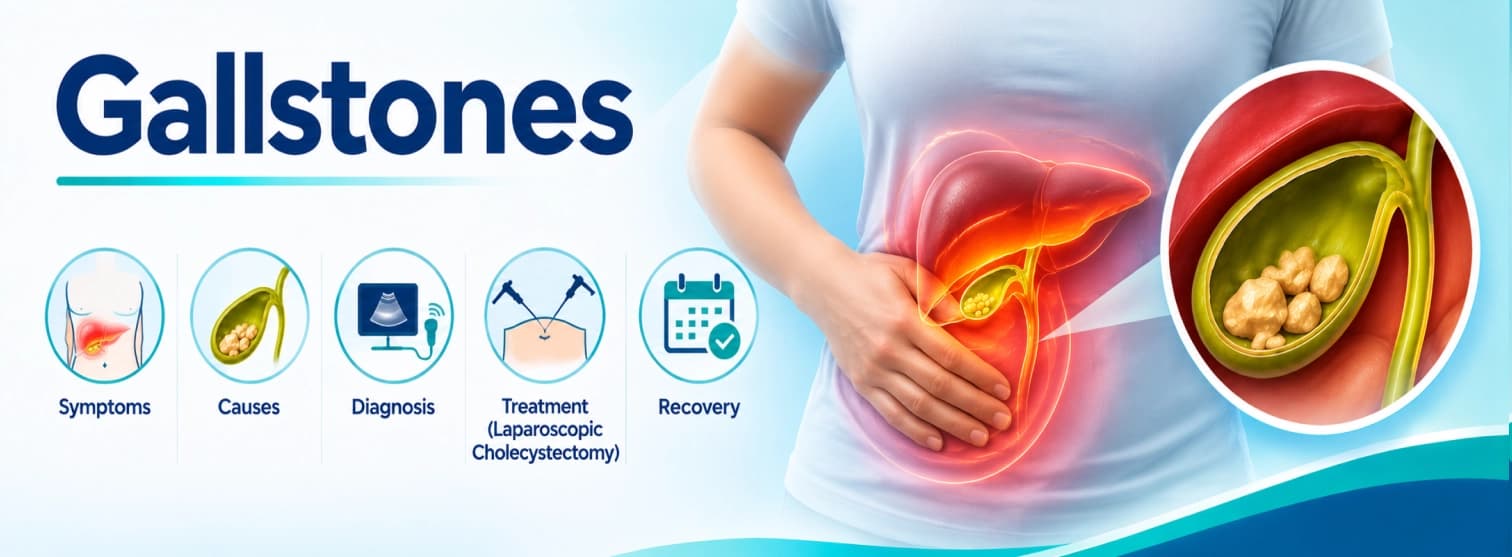
Synopsis
What Are Gallstones?
Your gallbladder is a small, pear-shaped pouch tucked directly beneath your liver. Its primary role is storing and concentrating bile, a yellowish-green digestive fluid produced by the liver to break down fats in your food.
When bile contains an excess of certain substances, or if the gallbladder does not empty completely, microscopic particles begin settling out of the liquid. Over time, these particles clump together into hard, pebble-like deposits known as gallstones (cholelithiasis).
Gallstones generally fall into two main categories:
Cholesterol Stones: By far the most common variety, accounting for roughly 80% of cases. They develop when your liver excretes more cholesterol than your bile can dissolve.
Pigment Stones: Dark brown or black stones formed when bile contains excess bilirubin, often seen in individuals with underlying liver conditions, biliary infections, or red blood cell disorders.
Gallstones can be as tiny as a grain of sand or grow as large as a golf ball. Some people have a single large stone, while others have dozens of small pebbles.
Primary Gallstones Causes and Risk Factors
Understanding gallstones helps explain why these deposits form in the first place. Gallstones develop because of an imbalance in bile chemistry combined with sluggish gallbladder movement.
Common contributing factors include:
- Excess Cholesterol in Bile: When the liver pumps out more cholesterol than bile salts can disperse, the excess solidifies into crystals.
- Incomplete Gallbladder Emptying: If the muscular walls of the gallbladder do not contract fully or often enough, stagnant bile becomes overly concentrated, accelerating crystal formation.
- Hormonal Influences: Oestrogen increases cholesterol concentrations in bile, while progesterone slows down gallbladder contractions. This explains why women, particularly during pregnancy, while taking oral contraceptives, or during hormone therapy, experience higher rates of gallstones.
- Dietary Patterns: Diets high in refined carbohydrates and saturated fats combined with low dietary fibre promote stone formation.
- Rapid Weight Loss: Losing weight too quickly through crash diets or rapid post-bariatric shifts prompts the liver to release extra cholesterol into the bile, increasing stone risk.
- Sedentary Lifestyle and Metabolic Syndrome: Obesity, insulin resistance, and type 2 diabetes significantly increase biliary cholesterol secretion.
- Family History: Having an immediate family member with gallstones doubles your likelihood of developing them.
Recognising Gallstones Symptoms
Many people carry gallstones without ever knowing it. These are referred to as "silent stones" and are often detected incidentally during a routine abdominal health check. Silent stones do not cause pain and rarely require intervention.
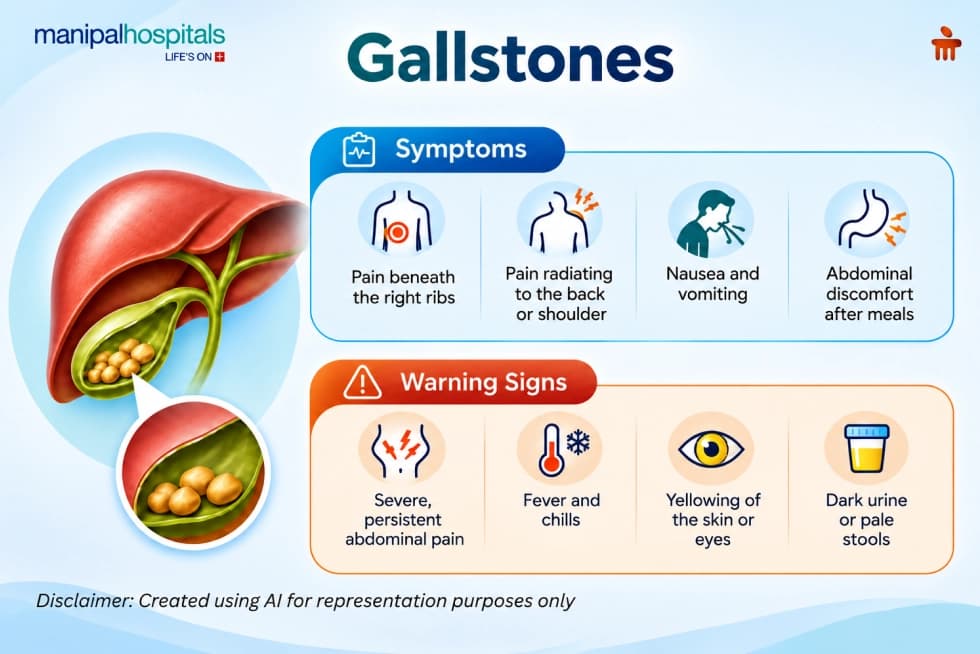
Trouble begins when a stone shifts and blocks the narrow exit tube of the gallbladder (the cystic duct). As the organ squeezes against this mechanical bottleneck, classic gallstones symptoms appear.
Typical gallbladder stone symptoms include:
Sudden, Steady Pain in the Upper Right Abdomen: A deep, aching or cramping sensation situated just below the right rib cage, typically beginning 30 to 60 minutes after a meal.
- Pain Radiating to the Back and Shoulder: Discomfort frequently spreads around the right flank to the shoulder blade or between the shoulders.
- Nausea and Vomiting: Many people feel intensely sick to their stomach, and vomiting rarely relieves the underlying pressure.
- Attacks Lasting Several Hours: Unlike intestinal gas that shifts and fades within minutes, a biliary attack usually peaks within an hour and persists steadily for two to six hours before subsiding.
- Restlessness: Changing sleeping postures, walking around, or passing gas does not ease the discomfort.
Red Flag Symptoms: When to Seek Immediate Medical Care
If a stone remains stuck in a bile duct, bacteria can multiply and cause acute infection or pancreatitis. Go directly to an emergency department if your pain comes with any of the following signs:
- Severe, unrelenting abdominal pain lasting longer than four to five hours
- A high fever accompanied by shaking chills
- Yellowing of your skin or the whites of your eyes (jaundice)
- Dark, tea-coloured urine or pale, clay-coloured stools
- Rapid heart rate and excessive sweating
Accurate Gallstone Diagnosis:
An accurate gallstones diagnosis can be made quickly, non-invasively, and painlessly:
- Abdominal Ultrasound: The undisputed gold standard for finding gallstones. It uses safe sound waves to detect stones as small as 1 to 2 millimetres, measures gallbladder wall thickness, and checks for signs of acute inflammation.
- Liver Function Tests (LFTs): Blood tests that check levels of bilirubin, alkaline phosphatase (ALP), and liver enzymes. Elevated numbers suggest that a stone may have slipped into the common bile duct.
- Serum Amylase and Lipase: Checked to ensure a migrating stone has not blocked the pancreatic duct, triggering pancreatitis.
- MRCP (Magnetic Resonance Cholangiopancreatography): A specialised, radiation-free MRI scan used when doctors suspect a stone is trapped deeper within the common bile duct.
Definitive Gallstone Treatment
Patients often ask whether gallstones can be dissolved with medicines or shattered with shockwaves. While oral bile acid tablets exist, they only work on tiny cholesterol stones, take years to produce modest results, and stones recur in almost all patients once tablets stop.
Because the underlying issue is a faulty gallbladder prone to forming stones, definitive gallstone treatment requires removing the organ itself. The gold standard worldwide is a laparoscopic cholecystectomy, commonly referred to as keyhole gallbladder stone surgery.
Why Laparoscopic Surgery Is the Preferred Choice
- High Success Rates: Keyhole surgery provides clear, magnified views of the surgical area, allowing surgeons to operate with remarkable precision.
- Low Conversion Rate: In routine elective practice, the need to convert from a keyhole procedure to an open surgical cut is very uncommon.
- Minimal Discomfort: Tiny 5 to 10 millimetre incisions mean far less post-operative muscle soreness compared to older open operations.
- Short Hospital Stay: Most patients are admitted on the morning of surgery and return home within 24 to 48 hours.
Recovery After Gallbladder Surgery
The timeline for recovery after gallbladder surgery is refreshingly short:
- The First 24 Hours: You are encouraged to get out of bed and walk around the hospital room a few hours after waking up from anaesthesia. Walking encourages bowel motility and helps clear residual gas used during surgery.
- Week 1: You can handle personal self-care, shower normally once dressings are secured, and enjoy light strolls. Most desk-based professionals return to work within 7 to 10 days.
- Weeks 2 to 4: Energy levels bounce back fully. You can resume driving, light exercise, and normal social schedules, avoiding heavy weightlifting (over 10 kilograms) for roughly four weeks.
Living Normally Without a Gallbladder
A very common worry is how digestion works once the gallbladder is gone. Your liver produces bile continuously, not the gallbladder. The gallbladder was merely a holding tank.
After surgery, bile simply drips steadily from the liver straight into your small intestine. For the first two to three weeks, your digestive system adapts to this steady flow, so doctors recommend eating smaller, low-fat meals to avoid loose stools. Within a month, almost all patients resume eating a varied, completely normal diet without restrictions.
Everyday Habits to Support Digestive Health
While surgery fixes existing stones, adopting sensible lifestyle habits supports long-term digestive and metabolic wellness:
- Eat Regular Meals: Skipping meals causes bile to sit idle in the biliary tree. Eating balanced meals at predictable times keeps bile circulating smoothly.
- Focus on Fibre: Incorporate oats, lentils, beans, fruits, and leafy vegetables into your daily plate to help clear excess cholesterol.
- Stay Physically Active: Aim for 30 minutes of moderate movement, like brisk walking, most days of the week to maintain a healthy weight and insulin sensitivity.
- Avoid Crash Diets: If losing weight, target a gradual, sustainable reduction of 0.5 to 1 kilogram per week rather than extreme fasts.
Conclusion
Gallstones are an exceptionally common condition, but experiencing an attack does not mean you face a difficult medical road. Modern diagnostics make identifying the problem painless, and advanced keyhole surgical techniques allow you to resolve the condition permanently with minimal downtime, tiny scars, and a swift return to your favourite routines. Listening to your body, seeking timely clinical advice, and choosing definitive care frees you from recurring pain and lets you enjoy your meals with confidence. For patients and families seeking advanced gastrointestinal care, high-definition laparoscopic surgery, and dedicated international patient coordination, consult the surgical gastroenterology team at Manipal Hospitals Global.
The Manipal Hospitals Global Advantage: World-Class Gallbladder Care
Choosing the right healthcare partner for your laparoscopic cholecystectomy is vital for a safe, stress-free recovery. Manipal Hospitals Global is a premier international destination for advanced gastrointestinal care, combining world-class surgical expertise with unparalleled hospitality for patients travelling from across the globe.
Our surgical gastroenterology department features ultra-modern, high-definition 4K laparoscopic setups and cutting-edge robotic surgical suites. This advanced infrastructure allows our highly experienced surgeons to operate with extreme precision through tiny 5 to 10 mm incisions. For you, this technology translates to minimal post-operative discomfort, near-invisible scarring, and a rapid return to daily life, with most patients returning home within 24 to 48 hours.
What truly sets us apart is our deeply specialized team of gastrointestinal surgeons who maintain a near-zero conversion rate from keyhole surgery to open procedures. To make your journey completely hassle-free, our dedicated International Patient Services team manages everything from medical visas and airport transfers to multilingual interpretation and customized post-operative dietary plans.
Share this Article


Not sure what you’re looking for?
Not sure what you’re looking for?
Get in touch with our representatives for
help!
Get in touch with our
representatives for help!