Knee Replacement Surgery in India for Bangladeshi Patients: Types, Hospitals & Recovery
Reviewed by: Orthopaedics & Joint Replacement Department
Posted on May 28, 2026
10 Min Read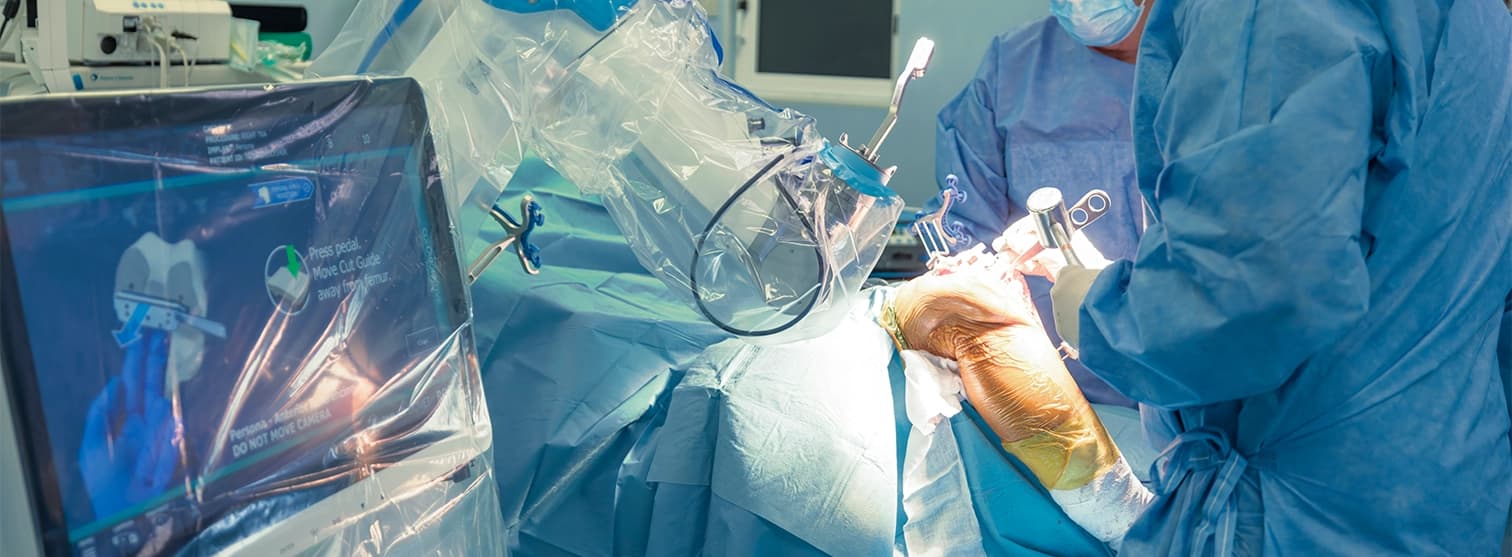
Synopsis
Why Bangladeshi Patients Choose India for Knee Joint Replacement
The decision to travel for surgery is never taken lightly. It involves navigating a foreign healthcare system, managing documentation across two countries, and trusting a surgical team you have never met. What consistently draws Bangladeshi patients to India, however, is not simply cost; it is the convergence of cost with genuine clinical quality that would be difficult to replicate anywhere else at this price point.
Unparalleled Clinical Scale and Experience
India performs more than 150,000 knee replacement surgeries annually, with leading orthopedic centers in Delhi, Bangalore, Mumbai, and Kolkata handling volumes that rival the busiest joint replacement programs in the United States and the United Kingdom. This volume matters clinically. Surgical outcomes in joint replacement are strongly correlated with institutional volume: hospitals that perform over 500 procedures per year consistently report lower infection rates, shorter operative times, reduced blood loss, and fewer implant positioning errors than low-volume centers.
For Bangladeshi patients, such expertise means access to surgeons who have performed the same procedure hundreds of times, surgeons who have encountered and managed every anatomical variation, every intraoperative complication, and every postoperative challenge that a complex knee reconstruction can present. The experience gap between a top-tier Indian orthopedic center and the best available option in Dhaka or Chittagong is significant, and it translates directly into patient outcomes.
Access to Advanced Surgical Robotics
Robotic knee replacement surgery has redefined what is achievable in joint reconstruction. Indian orthopedic centers at the tier-one level are equipped with systems such as the Mako Robotic-Arm Assisted platform (Stryker) and the ROSA Knee system (Zimmer Biomet), both of which provide pre-operative three-dimensional CT-based joint mapping and intraoperative real-time guidance that constrains the robotic arm to a surgeon-defined safe operating zone.
The clinical benefit is sub-millimeter implant positioning accuracy, a standard that manual instrumentation cannot reliably achieve, even in experienced hands. Correct implant alignment directly determines the longevity of the prosthesis (a misaligned implant wears asymmetrically and may require revision within a decade), the quality of post-operative range of motion, and the speed of rehabilitation. For Bangladeshi patients who will be returning home to continue recovery, getting the implant positioning right the first time is not a luxury; it is a clinical imperative. Robotic knee replacement surgery is now available at competitive pricing in India, making it accessible to international patients who would pay a significant premium for the same technology in Western countries.
Types of Knee Joint Replacement Surgeries Available in India
Understanding which procedure applies to your condition is the first step in making an informed surgical decision. Indian orthopedic centers offer the full spectrum of knee reconstruction surgery, from single-compartment resurfacing to complex multi-ligament revision procedures.
Total Knee Replacement
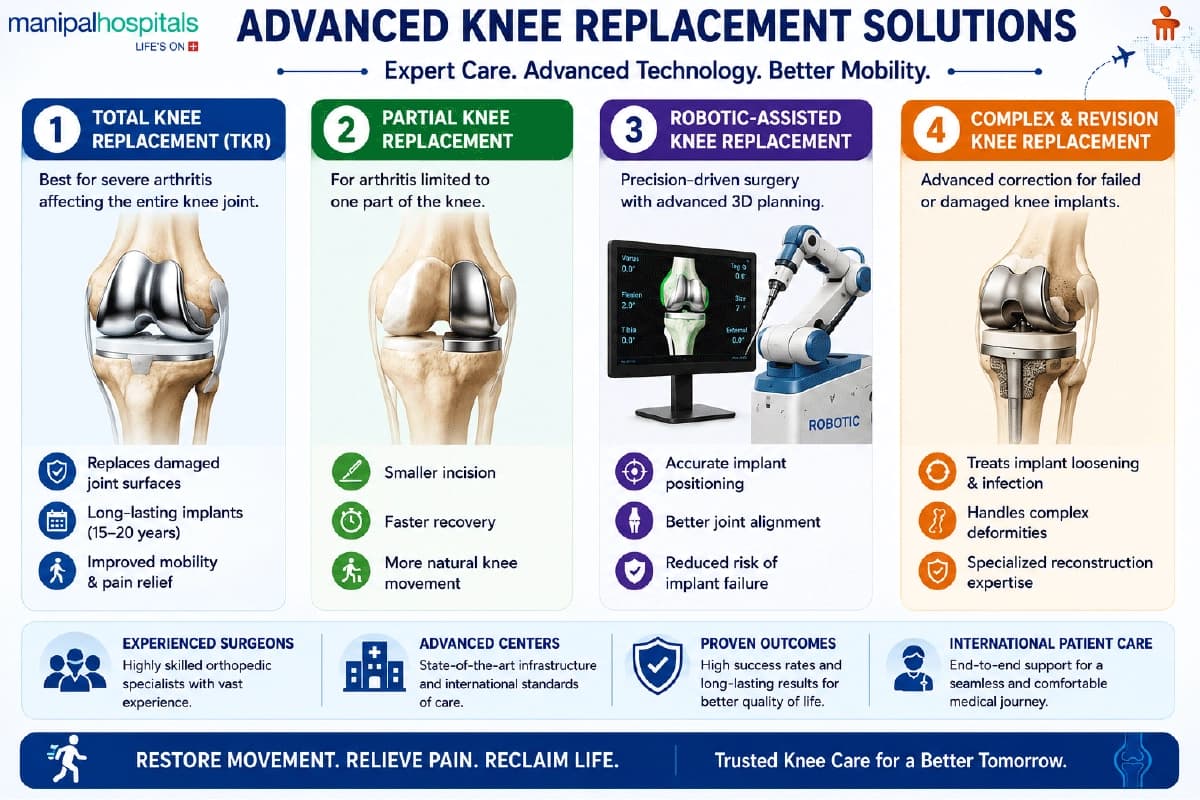
Total knee replacement (TKR), also referred to as total knee arthroplasty, is the most commonly performed procedure for patients with tri-compartmental osteoarthritis, rheumatoid arthritis, or severe post-traumatic joint destruction affecting the entire knee. The surgery involves resecting the damaged articular surfaces of the distal femur, proximal tibia, and, when indicated, the posterior surface of the patella and replacing them with metal and high-density polyethylene components that replicate the joint's natural geometry and biomechanics.
Modern cemented total knee replacement implants, from manufacturers including Zimmer Biomet, DePuy Synthes, Smith+Nephew, and Stryker, are designed to last 15–20 years under normal activity conditions, with longer survivorship increasingly documented in registry data. For patients with severe bilateral disease, staged bilateral TKR, with both knees addressed in the same hospital admission or in close succession, is a well-established approach that Indian orthopedic teams are experienced in managing.
Partial Knee Replacement
When arthritis is confined to a single compartment of the knee, most commonly the medial (inner) compartment, unicondylar knee arthroplasty (UKA), or partial knee replacement, offers a significantly less invasive alternative to total replacement. The procedure preserves the anterior and posterior cruciate ligaments along with the healthy compartments of the joint, resulting in a more natural post-operative feel, a faster recovery trajectory, and a smaller surgical incision.
Patient selection is the critical determinant of success. Ideal candidates have isolated single-compartment disease, intact cruciate ligaments, a body mass index below 35, and a reasonably good range of pre-operative motion. For appropriately selected Bangladeshi patients, unicondylar arthroplasty performed at a high-volume Indian center delivers excellent 10-year survivorship and a faster return to independent mobility than total replacement.
Robotic-Assisted Knee Replacement
Robotic-assisted knee replacement surgery does not replace the surgeon; it amplifies precision. The process begins with a pre-operative CT scan of the patient's knee, from which the robotic system generates a patient-specific three-dimensional model of the joint. The surgeon uses this model to plan implant size, positioning, and alignment in virtual space before a single incision is made.
Intraoperatively, the robotic arm provides real-time haptic and visual feedback, preventing the surgeon from making bone cuts outside the pre-planned safe zone. The result is consistently accurate implant placement that optimizes the mechanical axis of the limb, preserves soft tissue balance, and reduces the risk of the two most common causes of implant failure: malalignment and instability.
Robotic-assisted knee replacement in India represents the current standard of care for Bangladeshi patients with complex deformities, previous knee surgery, or elevated expectations for post-operative activity.
Complex or Revision Knee Replacement
Revision knee replacement, the surgical correction of a previously implanted prosthesis that has failed due to aseptic loosening, periprosthetic infection, instability, polyethylene wear, or implant fracture, is among the most technically demanding procedures in orthopedic surgery. It requires removal of well-fixed cemented components, management of significant bone loss, and reconstruction of the joint with constrained or semi-constrained revision implant systems that compensate for ligamentous deficiency.
India's leading orthopedic centers maintain dedicated joint revision programs staffed by surgeons with subspecialty training in complex reconstruction. For Bangladeshi patients who have undergone a primary knee replacement, whether in Bangladesh or abroad, and are experiencing implant failure, referral to a high-volume Indian revision center offers access to the full armamentarium of augmented revision systems, structural bone graft, and metal augments necessary to achieve a durable result. These are procedures that require institutional experience that only the highest-volume centers in the region can reliably offer.
Geographic Directory of Premier Orthopedic Centers
Choosing the right city and institution is as important as choosing the right procedure. Each major Indian medical hub offers a distinct combination of logistical convenience, clinical specialization, and international patient infrastructure.
Kolkata: The Localized Comfort Zone
For Bangladeshi patients, Kolkata is the most naturally accessible destination. Direct road and rail connections through the Benapole–Petrapole and Haridaspur–Gede border crossings, and direct flights from Dhaka and Chittagong, make the journey straightforward. Critically, Kolkata offers the significant advantage of Bengali linguistic compatibility; patients and families can communicate directly with clinical staff, reducing the anxiety and miscommunication that can accompany treatment in an unfamiliar language.
Leading institutions like Manipal Hospital Kolkata have established international patient departments with experience managing Bangladeshi cases. Knee joint replacement cost in India is generally competitive in Kolkata relative to Delhi or Mumbai, and the familiarity of the cultural environment reduces non-clinical stress during recovery.
Delhi / National Capital Region (NCR): The Technological Hub
The Delhi NCR corridor, encompassing hospitals in Gurugram, Noida, and central Delhi, represents the highest concentration of JCI-accredited orthopedic programs in India outside Mumbai. Institutions like Manipal Hospitals Global host orthopedic departments with dedicated robotic surgery programs, high-volume revision services, and the full range of implant systems from global manufacturers.
For Bangladeshi patients requiring robotic knee replacement surgery, complex revision procedures, or simultaneous management of significant medical comorbidities (cardiac, renal, or metabolic conditions that complicate perioperative management), Delhi NCR offers the greatest depth of multidisciplinary subspecialty support. Direct flights from Dhaka to Indira Gandhi International Airport are available with multiple carriers, and all major hospitals in this corridor have dedicated international patient concierge services, including Bangladeshi patient coordinators.
Bangalore: The Medical Capital
Bangalore has earned its reputation as India's medical capital through decades of investment in clinical protocol development, nursing excellence, and structured international patient programs. Hospitals like Manipal Hospitals Global maintain orthopedic departments that combine high surgical volume with rigorous quality management systems.
What distinguishes Bengaluru for Bangladeshi patients is the structured nature of the care pathway. Pre-operative assessment, implant selection, surgical planning, inpatient rehabilitation, and discharge coordination are managed through formally documented protocols with defined outcome benchmarks, a standard of clinical governance that provides patients and families with clear expectations at every stage. International patient desks at Bangalore’s major hospitals are experienced in managing medical visa coordination, insurance documentation, and inter-country medical record transfer for Bangladeshi nationals.
Legal and Regulatory Compliance for Medical Visas
Traveling to India for knee replacement surgery requires compliance with specific visa and regulatory requirements. Non-compliance can delay treatment, create legal complications, or result in denial of entry. This section provides the essential framework.
1. Choose a recognized Indian hospital (NABH/JCI accredited preferred).
2. Obtain a hospital reference letter confirming:
- Treatment details
- Estimated treatment duration
- Treating doctor’s name
3. Apply for an Indian Medical Visa (M-Visa) instead of a tourist visa.
4. Keep the following documents ready:
- Valid Bangladeshi passport
- Completed visa application form
- Passport-size photographs
- Hospital appointment/reference letter
- Financial proof (bank statements)
- Address proof
5. Submit the application through:
- Indian High Commission, Dhaka
- Assistant High Commission, Chittagong
6. Apply at least 4–6 weeks before travel.
7. Up to two attendants/family members can also apply for Medical Visas with relationship proof.
Clinical Rehabilitation and Recovery Milestones
The surgery itself is only the beginning. The quality of your physiotherapy and rehabilitation in the weeks following knee replacement determines your final functional outcome, how well you walk, how high you can climb stairs, and how fully you return to an active life.
Section | Key Highlights |
| Importance of Early Mobilization |
|
| Wound Healing and Post-Operative Stay |
|
| Guidelines for a Safe Return Journey |
|
Why India and Manipal Hospitals Global Are Preferred by Bangladeshi Patients
India has become a trusted destination for knee replacement surgery due to its combination of advanced orthopedic expertise, internationally accredited hospitals, modern surgical technology, and comparatively affordable treatment costs. For Bangladeshi patients, the added advantages of geographical proximity, cultural familiarity, and convenient travel connectivity make the treatment journey more manageable and comfortable.
Manipal Hospitals Global offers comprehensive care across every stage of treatment — from pre-surgical evaluation and advanced joint replacement procedures to rehabilitation, recovery support, and international patient assistance. Dedicated care teams help patients with medical visa documentation, treatment coordination, interpreter support when required, and post-operative planning for a smoother experience.
Share this Article


Not sure what you’re looking for?
Not sure what you’re looking for?
Get in touch with our representatives for
help!
Get in touch with our
representatives for help!