
Breast Cancer Treatment for International Patients: Diagnosis, Recovery and Costs
Reviewed by: Cancer Care Department
Posted on Mar 12, 2026
10 Min Read

Synopsis
- The Treatment Journey for International Patients
- Breast Cancer Surgery: The First Step for Many Patients
- Systemic Treatments: Targeting Cancer Cells Throughout the Body
- Chemotherapy for Breast Cancer
- Radiation Therapy for Breast Cancer
- Hormone Therapy for Breast Cancer
- Understanding Breast Cancer Survival Rates
- Treatment Duration and Recovery Timeline
- Cost Considerations for International Patients
- Conclusion
The Treatment Journey for International Patients
Travelling internationally to seek medical care is not just about scheduling a procedure. Hospitals that provide care to international patients have a well-organised system in place to provide a comfortable and organised experience.
However, the journey actually begins well before the patient arrives at the hospital. The following are the steps involved in the process:
- Initial medical review: In this step, the medical team reviews medical reports such as biopsy reports, mammography, and scan reports electronically before travelling.
- Virtual consultation: In this step, the medical team of oncologists will discuss the medical condition, the stage of the cancer, and the type of treatment that will work best for the patient.
- Treatment planning: At this stage, the medical team will develop a treatment plan that is tailored to the needs of the patient’s condition.
- Travel coordination: At this stage, the medical team will ensure that the patient gets the medical visa, accommodations, and interpreter service.
- Arrival and diagnostic confirmation: At this stage, the medical team might carry out further tests to confirm the treatment plan.
- Active treatment phase: At this stage, the medical team will use various forms of treatment, such as surgery, systemic treatment, and radiation, to treat the patient’s condition.
- Follow-up and recovery planning: In this step, the medical team will assist the patient in the recovery process once the treatment is over.
Breast Cancer Surgery: The First Step for Many Patients
Surgery often forms the central part of breast cancer treatment, particularly when the disease is detected at an early or localised stage. The aim is to remove the tumour while preserving as much healthy tissue as possible and preventing spread to nearby structures.
The type of breast cancer surgery recommended depends on tumour size, location, stage, and patient preferences. Common surgical approaches include:
- Breast-conserving surgery (lumpectomy): Only the tumour and a small margin of surrounding tissue are removed. The breast shape is largely preserved.
- Mastectomy: The entire breast tissue is removed when the tumour is large or involves multiple areas.
- Sentinel lymph node biopsy: The first group of lymph nodes from the breast is examined for the presence of metastatic disease.
- Axillary lymph node dissection: Additional lymph nodes may be removed if cancer cells are detected.
Reconstructive procedures may also be discussed, either during the same operation or at a later stage. Surgical techniques today aim to minimise scarring and maintain body symmetry wherever possible.
Systemic Treatments: Targeting Cancer Cells Throughout the Body
While surgery removes visible disease, microscopic cancer cells may still exist elsewhere in the body. Systemic therapies have been developed to address this possibility and minimize the recurrence of cancer.
The need for additional therapies is decided by the doctor based on the biology of the tumor, hormone receptors, HER2, and the involvement of the lymph nodes.
Chemotherapy for Breast Cancer
Chemotherapy for breast cancer employs special drugs that travel through the bloodstream to kill rapidly reproducing cancer cells. The treatment is given before the operation (neoadjuvant therapy) to reduce the tumor or after the operation (adjuvant therapy) to eliminate cancer cells.
Chemotherapy is usually delivered in cycles, allowing the body time to recover between sessions. Doctors closely watch the blood counts and the functioning of the organs while giving the treatment.
Radiation Therapy for Breast Cancer
The radiation therapy for breast cancer aims to kill the remaining breast cancer cells in the breast or the nearby lymph nodes with high-energy beams of radiation. This is usually advised following breast-conserving surgery or mastectomy in cases with a higher risk of recurrence.
The treatment is given in several sessions, with each session lasting only a few minutes. Modern technology allows doctors to direct the beams of radiation to the affected areas with minimal damage to the surrounding tissue.
Hormone Therapy for Breast Cancer
Breast cancers develop in some women in response to the presence of hormones such as oestrogen or progesterone. In such cases, hormone therapy for breast cancer helps block or reduce the body's hormone production.
These medicines may be taken as tablets or injections for several years after initial treatment. By slowing or stopping hormone-driven tumour growth, they play an important role in preventing cancer from returning.
Understanding Breast Cancer Survival Rates
When exploring treatment options, many people want to know about long-term outcomes. The breast cancer survival rate has improved significantly over the past two decades due to earlier detection, advanced imaging, and more effective therapies. Outcomes vary depending on when the disease is diagnosed.
- Early-stage breast cancer: The 5-year survival rate is often above 90%, especially when detected early.
- Cancer spread to nearby lymph nodes: Survival rates remain high, typically around 80–85% with treatment.
- Advanced (metastatic) breast cancer: The average 5-year survival rate is about 30%, but modern targeted therapies and newer medicines are helping many patients live longer.
These statistics reflect averages across large groups of patients. Your individual outlook depends on factors such as the stage of the cancer, tumour biology, and the treatment plan recommended by your doctor.
Treatment Duration and Recovery Timeline
One of the main concerns for international patients is the duration of their stay in the treatment country. Some of the treatments take weeks, while some take months.
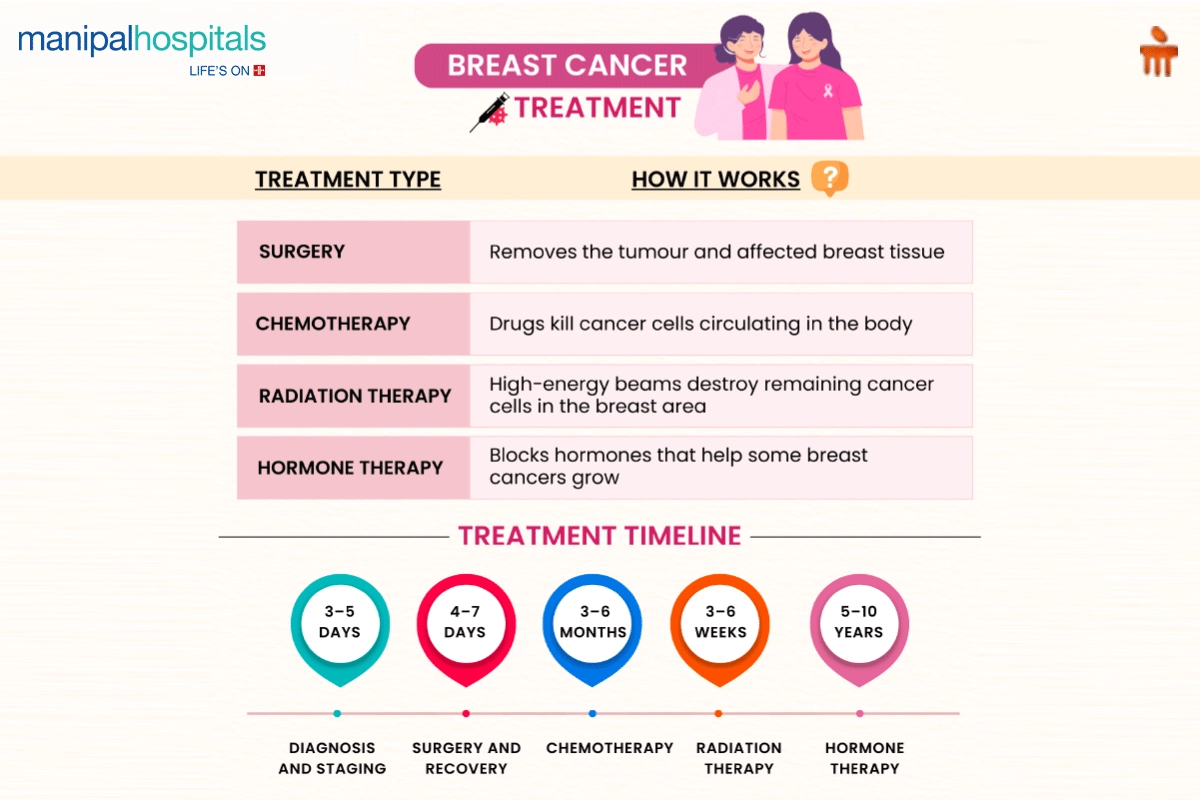
Stage of Care | Typical Duration | Purpose of the Stage | Monitoring Required |
Diagnostic confirmation | 3–5 days | Imaging, pathology review, staging scans | Specialist consultations and tumour board review |
Surgical treatment and hospital recovery | 4–7 days | Removal of tumour and lymph node evaluation | Post-operative wound care and early recovery monitoring |
Chemotherapy cycles | 3–6 months | Systemic control of microscopic cancer cells | Blood tests and treatment response assessment |
Radiation therapy course | 3–6 weeks | Targeted treatment to eliminate residual cancer cells | Weekly treatment planning reviews |
Long-term hormonal therapy | 5–10 years | Prevention of hormone-driven recurrence | Periodic follow-ups and medication review |
Cost Considerations for International Patients
Financial planning is an essential aspect of preparing for treatment in another country. The cost of treatment may differ depending on the type of therapy, the hospital's facilities, and the type of cancer.
Several factors affect the cost of breast cancer treatment. These include:
- Type of cancer, stage, and therapy needed
- Duration of hospitalization
- Use of advanced diagnostic techniques like imaging and molecular diagnostics
- Surgery for reconstruction of the breast
- Medication during chemotherapy and/or target therapy
- Rehabilitation and follow-up care
Most hospitals have dedicated departments for international patients that assist in cost estimation prior to admission and provide support for insurance documentation.
Clear financial counselling helps patients focus on recovery rather than uncertainty about expenses.
Conclusion
Facing breast cancer is never easy, and the idea of travelling abroad for treatment may initially feel overwhelming. Yet many international patients find reassurance in structured care systems where specialists from multiple disciplines work together to design personalised treatment plans. From advanced breast cancer surgery to carefully tailored chemotherapy and radiation protocols, modern oncology has transformed the way this disease is managed. For those exploring international options, Manipal Hospitals Global offers coordinated care pathways through its Cancer Care speciality, designed specifically for overseas patients and helping them navigate treatment, travel arrangements, and recovery with confidence.
Share this Article


Not sure what you’re looking for?
Not sure what you’re looking for?
Get in touch with our representatives for
help!
Get in touch with our
representatives for help!



