Bronchoscopy Test: Benefits, Procedure, and Recovery
Bronchoscopy Test: Uses, Procedure, and Recovery for International Patients
Reviewed by: Cardiothoracic Vascular Surgery Department
Posted on Apr 21, 2026
6 Min Read
Share this Article
Not sure what you’re looking for?
Not sure what you’re looking for?
Get in touch with our representatives for help!
Get in touch with our representatives for help!
Cardiothoracic Vascular Surgery Blogs
Most of us don’t notice our breathing until something feels off. A lingering cough or a tight feeling in the chest can slowly become impossible to ignore. These symptoms may seem small at first, but if they last, they usually mean that a more thorough evaluation is needed.
This is where a bronchoscopy test becomes important. It is a minimally invasive procedure that allows doctors to see inside the airways and lungs, helping identify the cause of respiratory issues. For international patients, access to advanced diagnostics and expert care abroad can make the process smoother and more reassuring.
This blog will explain what the procedure involves, how it is done, what to expect during bronchoscopy preparation, and how long recovery usually takes.
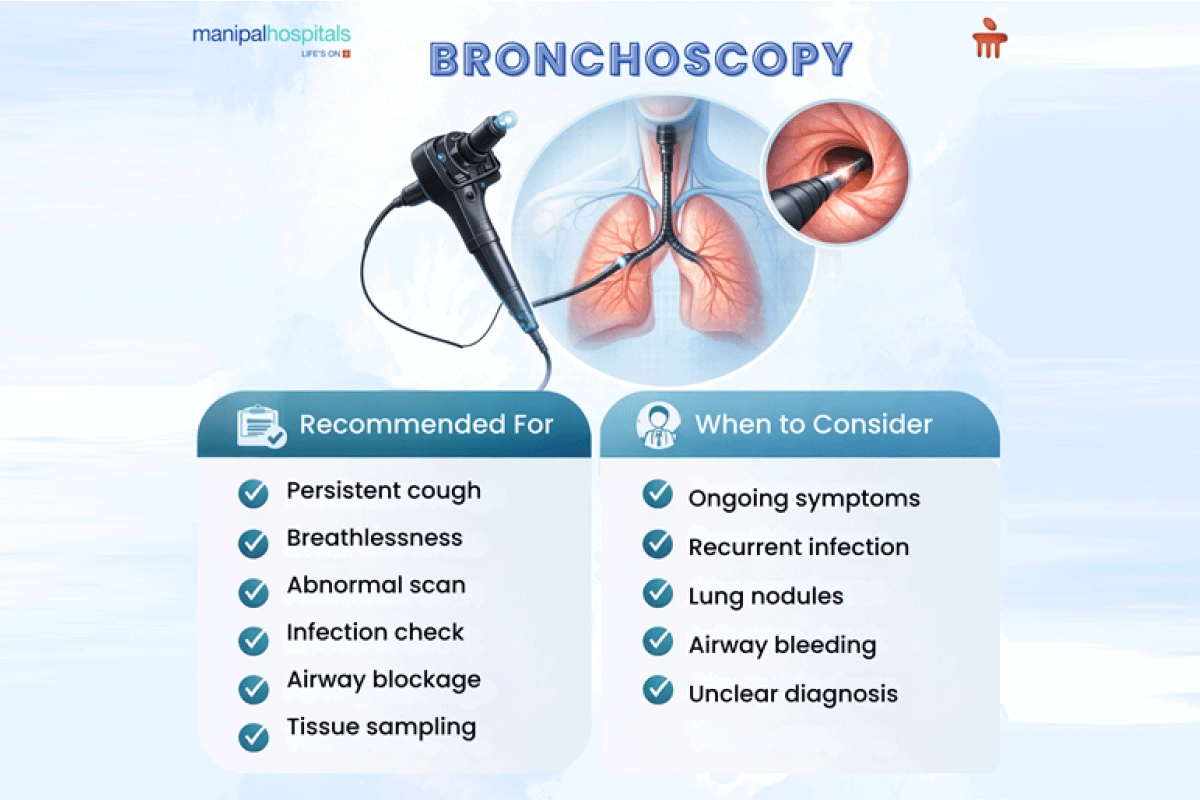
A bronchoscopy test helps doctors examine the airways, including the trachea and bronchi, using a thin tube with a camera. It shows real-time images of the lungs and helps identify the cause of breathing problems. It is mainly used for diagnosis but can also help in certain treatments, like removing blockages or mucus.
There are two main types:
Flexible bronchoscopy: Uses a thin, bendable tube to reach deeper areas with less discomfort
Rigid bronchoscopy: Uses a straight tube, usually for specific cases like heavy bleeding or large blockages
Understanding the procedure can help patients feel more prepared and less anxious.
Uses of a Bronchoscopy Test
Doctors use a bronchoscopy test in different situations to get a clearer view of the airways and understand what’s causing the problem. It is commonly used to:
Find out why symptoms like cough or breathlessness are not improving
Examine the airways when scans show something unusual
Check for infections, inflammation, or other lung conditions
Take samples through a lung biopsy procedure for detailed testing
Remove mucus, clear blockages, or take out foreign objects when needed
When Should You Get a Bronchoscopy Test?
In clinical practice, bronchoscopy is often recommended when imaging alone does not provide clear answers. Some common signs include the following:
Persistent cough that does not improve
Unexplained shortness of breath
Lung infections that keep returning
Suspicious lung nodules or masses
Bleeding from the airways
Evaluation before or after a lung biopsy procedure
In numerous instances, the bronchoscopy can help doctors find out what's wrong early, which can lead to better treatment and better results.
Understanding the Bronchoscopy Procedure
Bronchoscopy is usually done with local anesthesia and mild sedation. In some cases, general anaesthesia is used if the procedure is more complicated. This is what typically happens during a bronchoscopy:
The throat is numbed to minimise discomfort
A bronchoscope is gently inserted through the nose or mouth
The doctor examines the airways in real time
If required, a lung biopsy is performed to collect tissue samples
The scope is carefully removed
A bronchoscopy typically takes 30 to 60 minutes, depending on what the doctor finds and whether they need to take a small lung sample.
Bronchoscopy Preparation: What You Need to Know
Proper preparation for bronchoscopy ensures the procedure goes smoothly and safely. Here are the usual steps:
Fasting for at least 6–8 hours before the test
Informing the doctor about medications, especially blood thinners
Arranging transportation after the procedure due to sedation
Completing basic blood tests or imaging, if required
Taking these steps to prepare for a bronchoscopy lowers the risks and makes the test more accurate.
Role of Lung Biopsy in Bronchoscopy
During a bronchoscopy, a lung biopsy is often done to get tissue samples. This procedure helps find out the following:
Lung infections
Inflammatory conditions
Lung cancer
Interstitial lung diseases
A lung biopsy done through bronchoscopy is less invasive than a surgical biopsy and lets you heal faster.
Comparison of Bronchoscopy Uses
Different types of bronchoscopy are used in different situations, and this table helps you understand each one.
New technology has made the bronchoscopy test safer and more useful. Some of the main benefits include:
High accuracy in diagnosing lung conditions
Minimally invasive approach
Ability to perform a lung biopsy during the same session
Short bronchoscopy recovery time
Reduced need for major surgery
These benefits make bronchoscopy one of the most accurate diagnostic tools for patients from other countries.
Bronchoscopy Recovery Time
Compared to surgery, the recovery time after a bronchoscopy is usually short. After a bronchoscopy test, patients might feel a mild throat discomfort, temporary hoarseness, or a slight cough. Most people feel better within a few hours, but it may take up to 24 hours for them to fully recover from bronchoscopy, depending on how sedated they were and whether or not a lung biopsy was done.
Doctors recommend that patients:
Avoid eating until the numbness goes away
Avoid driving for 24 hours till the sedation effect subsides
Minor blood-tinged sputum can occur after a biopsy
Take a rest for the rest of the day
Follow the exact steps given after bronchoscopy preparation
It doesn't take long to recover from a bronchoscopy, so it's a good option for diagnosis.
Conclusion
Breathing problems can significantly affect your daily life, but with today’s advanced diagnostic techniques, identifying the cause has become more precise and reassuring. A bronchoscopy is a safe, minimally invasive procedure that allows specialists to closely examine the airways and lungs, helping detect infections, blockages, or other underlying conditions with high accuracy.
At Manipal Hospitals Global, the Department of Cardiothoracic Vascular Surgery is supported by experienced cardiothoracic surgeons who work closely with multidisciplinary teams to ensure expert evaluation and personalised care. The procedure is designed for patient comfort, offering benefits such as accurate diagnosis, minimal discomfort, and quick recovery. In most cases, bronchoscopy is performed as a day-care procedure, allowing patients to be discharged on the same day.
For seamless international patient services, Manipal Hospitals Global provides end-to-end treatment experience. From pre-arrival planning and travel assistance to coordinated care, interpreter services, and post-procedure follow-up, every step is managed with precision and compassion, ensuring a smooth and stress-free healthcare journey.