Kidney Failure Symptoms: When Is a Kidney Transplant Needed?
Reviewed by: Nephrology Department
Posted on Oct 16, 2026
8 Min Read
Synopsis
What Happens When the Kidneys Begin to Fail?
Healthy kidneys filter roughly 120 to 150 quarts of fluid from the blood each day, removing metabolic waste, producing urine, and maintaining the balance of electrolytes such as sodium, potassium, and calcium. When kidney function declines, waste toxins and fluid accumulate in the bloodstream, straining the heart and brain.
Kidney failure occurs in two distinct clinical forms:
- Acute Kidney Failure: Develops rapidly over hours or days due to sudden trauma, severe infection, or toxic injury. It can often be reversed with timely intensive treatment.
- Chronic Kidney Failure: Develops gradually over months or years as progressive conditions, such as diabetes or hypertension, permanently damage renal tissue, eventually leading to end-stage kidney disease.
Kidney Failure Symptoms You Should Not Ignore
Kidney problems can stay quiet for quite some time. In the early stages, a person may have very few symptoms, sometimes none that seem unusual. As kidney function drops severely, though, the picture can change.
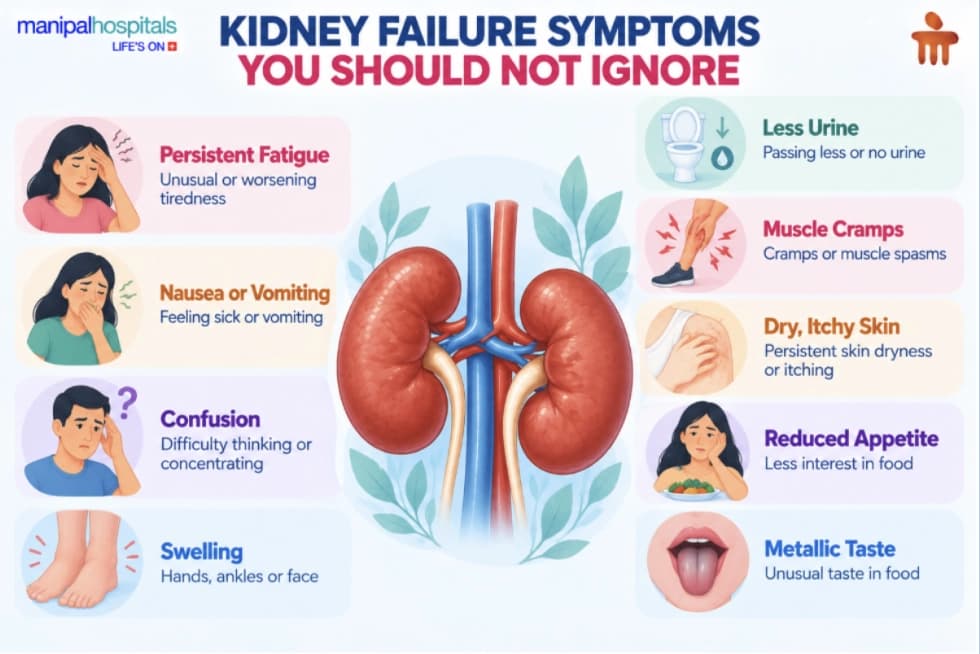
Some of the symptoms linked with severe loss of kidney function include:
- Fatigue, which may feel persistent or more pronounced than usual
- Nausea or vomiting
- Confusion or difficulty concentrating
- Swelling around the hands, ankles or face
- Passing less urine than usual, or not passing urine
- Muscle cramps or spasms
- Dry or itchy skin
- Reduced appetite
- A metallic taste in food
There is no single symptom that, by itself, confirms kidney failure. These changes need to be considered alongside tests that show how the kidneys are working. Blood and urine tests are used for this, while a kidney ultrasound or other imaging may be needed in some cases.
When Does Kidney Failure Become a Reason to Consider a Transplant?
When the kidneys can no longer keep up with the body’s needs, dialysis or kidney transplant may be needed. These are the two main treatments for kidney failure. For eligible people with end-stage kidney disease, a kidney transplant is often preferred over long-term dialysis. However, suitability depends on the person's overall health, transplant evaluation, donor availability and individual circumstances. A person does not necessarily have to wait until dialysis has started before a transplant is considered.
Kidney function | What this means for transplant planning |
Kidney function is declining | The focus is on the underlying kidney disease and how kidney function changes over time. |
Kidney function is severely reduced | Dialysis and transplantation may need to be considered. |
End-stage kidney disease | Transplant may be considered as a treatment for kidney failure in someone who is medically suitable. |
Does Dialysis Have to Start Before a Kidney Transplant?
Not necessarily. Some medically suitable patients may undergo a transplant before dialysis is needed. This is known as a pre-emptive kidney transplant.
If transplantation is not possible immediately, dialysis may be needed to perform some of the functions of the kidneys while the person remains on the transplant pathway.
How Doctors Decide Whether You Are Suitable for a Kidney Transplant
A kidney transplant is not decided on kidney function alone. Before surgery, the transplant team needs a clearer picture of the person’s overall health. The evaluation looks at whether the person can safely undergo the operation and whether there are conditions that could affect the transplant.
The assessment can include:
- Blood and other laboratory tests
- Evaluation of the heart and other organs
- Screening for active infections
- Checking for cancer or other conditions that could affect transplant outcomes
- Assessment of the support, understanding, and ability needed to manage medicines and pre and post transplantation care
- Evaluation of whether the person can follow the treatment and medicines needed after transplantation
A living donor goes through a separate assessment as well. The team checks the donor’s general health, kidney function, anatomy and suitability for surgery. Blood-group compatibility, tissue typing and cross-matching are also considered. The donor must be medically and psychologically fit and should be making the decision freely.
Living donor
A living donor may be a close relative or spouse in accordance with applicable transplant rules. Donation by someone who is not a near relative may require additional approval. The donor and recipient are both evaluated before the transplant is cleared.
Deceased donor
With a deceased donor kidney, the process is different because the kidney is allocated from the available donor pool. Registration, medical suitability and matching are considered before a kidney can be allocated.
Certain conditions can make transplantation unsuitable or require further assessment. These include active cancer, serious infection, significant heart or other organ disease, and some major psychological or social concerns. The final decision is made after the transplant team has completed the evaluation.
What a Kidney Transplant Means for Life After Surgery
The transplant itself is a major operation, but there is quite a bit that comes after it. During the surgery:
- The donor kidney is usually placed in the lower part of the abdomen.
- Surgeons connect its blood vessels to blood vessels in the recipient’s body.
- The ureter from the new kidney is connected to the bladder.
- The original kidneys are generally left where they are. They are removed only when there is a specific medical reason to do so.
Long-term part of living with a transplanted kidney:
- Anti-rejection medicines: The immune system can see the new kidney as foreign and try to attack it. Medicines are therefore needed for life to reduce the risk of rejection.
- Infections: These medicines suppress the immune system, so infections can become more likely.
- Possible medicine-related effects: Immunosuppressive medicines can increase the risk of conditions such as high blood pressure, diabetes, infections, bone problems, and certain cancers. The specific risks vary depending on the medicines used and the person's health.
- Regular blood tests: Follow-up does not stop after surgery. Blood tests help the transplant team see how the new kidney is working and pick up problems early.
- Rejection can be quiet: A person may not feel anything unusual when rejection starts. Regular follow-up is important even when everything seems fine.
When Should You Seek Medical Attention?
Seek urgent medical care if you develop severe breathlessness, chest pain, confusion, loss of consciousness, very little or no urine, or rapidly worsening swelling. These symptoms can have several causes, including serious complications of advanced kidney disease, and need prompt assessment.
Conclusion
Kidney failure can develop gradually, and symptoms may not show up until kidney function has fallen considerably. So, symptoms alone cannot tell you when a transplant is needed. As kidney function becomes severely reduced, dialysis or transplantation may need to be considered. A transplant is not a cure for kidney failure. It requires lifelong anti-rejection medicines and regular follow-up to protect the transplanted kidney.
If you or a loved one has advanced kidney disease, consult our kidney transplant specialists at Manipal Hospitals to understand whether transplantation may be appropriate and what the next steps could be.
Kidney Transplant Services at Manipal Hospitals Global
Patients exploring kidney transplantation in India can consult the relevant specialists at Manipal Hospitals Global to understand their condition and available treatment options. The Nephrology Department works with the kidney transplant team to assess kidney function, the progression of kidney disease, overall health, suitability for transplantation and the need for dialysis or other treatment options. The evaluation may also involve transplant surgeons and other specialists, depending on the patient's medical needs.
International patients can enquire about video consultations to discuss their medical reports and current diagnosis, as well as second opinions to better understand their treatment options. These consultations can help patients understand the transplant evaluation process, the investigations required and whether further assessment in India may be appropriate.
For patients considering transplantation, the evaluation includes assessing the recipient's fitness for surgery and reviewing donor availability, compatibility and applicable legal and regulatory requirements. The treating team can explain the potential benefits and risks of transplantation, the need for lifelong immunosuppressive medication and the follow-up care required after surgery.
The international patient services team can assist with information about consultation arrangements, medical documentation, appointments and coordination of care in India. Patients can contact the team to understand the available services and the steps involved in planning a kidney transplant evaluation.
Share this Article


Not sure what you’re looking for?
Not sure what you’re looking for?
Get in touch with our representatives for
help!
Get in touch with our
representatives for help!