Loading...

98, HAL Old Airport Road, Kodihalli, Bengaluru, Karnataka 560017
Accreditations


Copyright © 2025 Manipal Hospitals - All Rights Reserved
Reviewed by: Obstetrics and Gynaecology Department
Posted on Apr 24, 2026
11 Min Read
Endometriosis happens when tissue that looks like the lining of the uterus grows outside of the uterus. These growths can show up on the ovaries, fallopian tubes, pelvic lining, or even further out. Endometrial-like tissue responds to hormones but cannot shed normally, leading to inflammation and scarring. To pick the best endometriosis treatment plan, you need to know what this condition is. If left untreated, these cases can have a big impact on daily life and reproductive health, but they are not life-threatening.
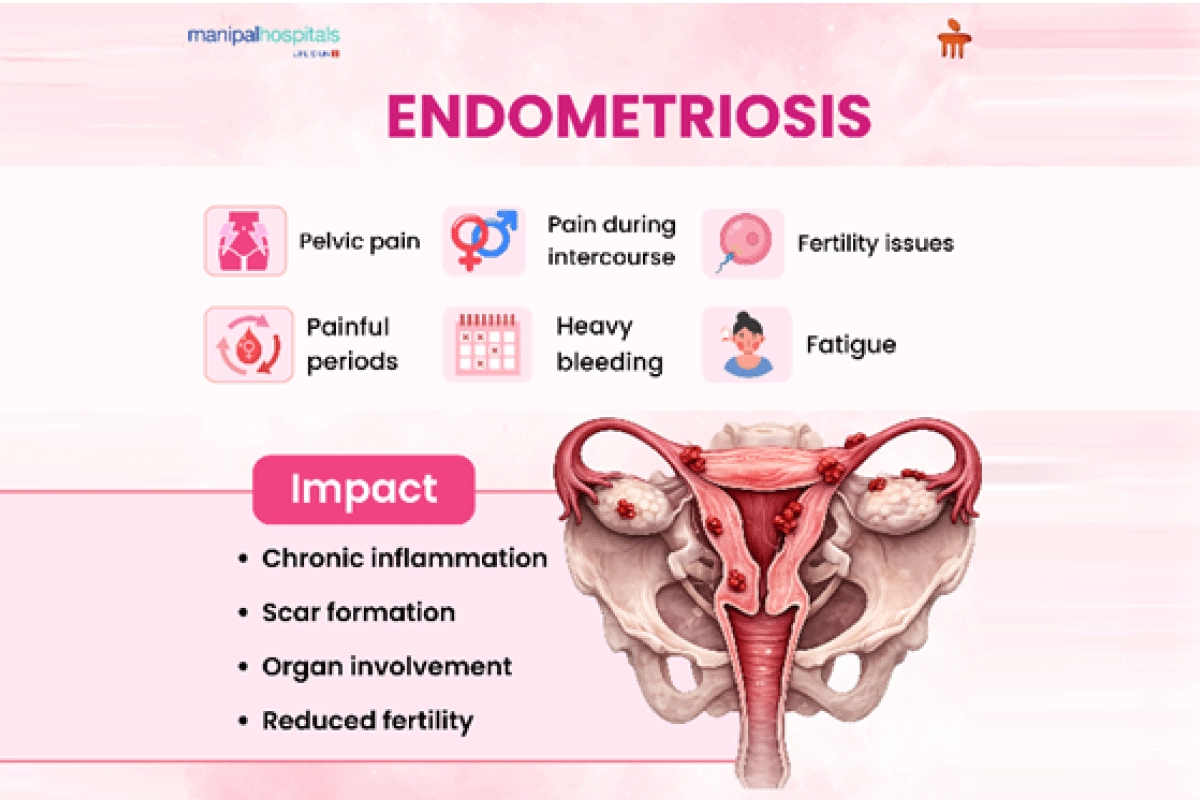
The exact cause of endometriosis is still not fully understood, and it likely develops due to a combination of factors rather than a single reason. Research suggests that biological, hormonal, and genetic influences all play a role in how the condition begins and progresses.
Initial symptoms can be tricky to spot and differ a lot from one person to another. Some women get severe pain, while others notice nothing, even with advanced disease. Women with endometriosis often have these symptoms:
Did you know endometriosis affects nearly 1 in 10 women of reproductive age worldwide, yet diagnosis can take 6–8 years on average? Recognising these symptoms early supports prompt diagnosis through ultrasound, MRI, and diagnostic laparoscopic procedures for better outcomes.
Diagnosing endometriosis can be challenging, as symptoms often overlap with other conditions. Doctors typically begin with a detailed medical history and physical examination, followed by imaging tests to get a clearer picture.
Diagnostic Method | Description |
Ultrasound | This is often the first imaging test used. While it may not detect small endometriosis lesions, it can help identify cysts (endometriomas) associated with the condition. |
MRI (Magnetic Resonance Imaging) | MRI provides more detailed images and is useful in assessing the extent and depth of endometriosis, especially in complex or deep cases. |
Laparoscopy | Considered the gold standard for diagnosis, this is a minimally invasive surgical procedure where a thin camera is inserted through a small incision in the abdomen to directly view endometrial tissue. It also allows doctors to confirm the diagnosis and, in many cases, remove or treat the lesions during the same procedure. |
A combination of these approaches helps ensure accurate diagnosis and guides the most effective treatment plan.
For many women who need advanced care, medical tourism is now a viable option. Hospitals in other countries often provide you with access to the following:
Seeking treatment abroad for complex or recurring endometriosis can offer renewed hope and improved outcomes.
The choice of treatment depends on the severity of symptoms, age, and fertility goals. Endometriosis is often classified into stages I–IV, from mild to severe. Doctors usually create a treatment plan based on individual needs.
Stage | Severity & Description |
Stage I (Minimal) | Small, superficial implants with little to no scar tissue. Symptoms may be mild or even go unnoticed. |
Stage II (Mild) | Slightly deeper implants with minimal scar tissue. Pain may be more noticeable, especially during periods. |
Stage III (Moderate) | Multiple deep implants, small ovarian cysts (endometriomas), and some scar tissue. Symptoms are typically more persistent and impactful. |
Stage IV (Severe) | Extensive deep implants, large ovarian cysts, and significant scar tissue or adhesions. This stage often involves severe pain and may affect fertility. |
Beyond the stages, managing endometriosis involves a range of treatment approaches tailored to the severity of symptoms, overall health, and fertility goals. From medications to advanced surgical techniques, the focus is on relieving pain, controlling disease progression, and improving quality of life.
Taking medication is often the initial step in managing symptoms. These are:
Medications can help, but they may not get rid of the problem completely. They are often combined with other treatments.
If symptoms persist or interfere with daily life, surgery might be recommended. The goal is to remove or destroy abnormal tissue, ease pain, and boost organ function. Minimally invasive techniques are usually preferred for quicker recovery.
Laparoscopic endometriosis surgery is one of the most advanced methods available today. This procedure requires small cuts to be made so that a camera and surgical tools can be put inside. Surgeons can carefully remove endometrial tissue without harming healthy organs.
Benefits of laparoscopic endometriosis surgery include:
Many women think that laparoscopic endometriosis surgery is the best way to treat endometriosis today.
In more serious cases, a more thorough intervention may be needed. People with severe endometriosis often receive treatment that includes:
Getting the right treatment for severe endometriosis is vital. It can make a real difference to how you feel down the line and help stop it from flaring up again.
Endometriosis can make it harder to become pregnant, but many women still conceive with the right care. The goal of endometriosis fertility treatment is to improve reproductive outcomes by:
Specialised programmes often combine surgical and fertility care to improve outcomes.
The table below gives a clear overview
Treatment Type | Approach | Best For | Benefits | Limitations |
Medical Therapy | Hormonal & pain relief medications | Mild symptoms | Noninvasive way to manage pain and discomfort | Relief is temporary; symptoms may return once medication is stopped; possible side effects from hormones |
Endometriosis Surgery | Removal of lesions | Moderate to severe cases | Can provide long-term relief from pain | Surgery carries risks; disease may recur over time |
Laparoscopic Endometriosis Surgery | Minimally invasive surgery | Most patients | Faster recovery, smaller scars, more precise removal | Not always effective for deep or widespread disease; may need repeat procedures |
Treatment for Severe Endometriosis | Advanced surgical care | Deep infiltrating endometriosis(DIE) | Comprehensive management of complex cases | Higher surgical risks, longer recovery, and may affect fertility, depending on the extent of the disease |
Endometriosis Fertility Treatment | Reproductive-focused care | Women trying to conceive | Improves chances of pregnancy | May not relieve pain symptoms; success rates vary; can be emotionally and financially demanding |
Women who travel for endometriosis treatment often get the following:
Facilities like these make sure severe endometriosis treatment gets done properly and spot on.
How long it takes to recover depends on the type of endometriosis surgery you have. Most people who have laparoscopic surgery are able to return to their usual activities within a few weeks.
Combining surgery with ongoing care makes endometriosis treatment more effective and lowers the risk of it coming back.
Endometriosis can be difficult to handle, but it can be managed with the right support and access to good medical care. Doctors have found that diagnosing it early leads to much better results and a better quality of life. At Manipal Hospitals Global, experienced gynaecologists provide comprehensive evaluation and personalised treatment for women at every stage of the condition.
Women who come to Manipal Hospitals Global for endometriosis treatment from abroad receive advanced laparoscopic care, tailored treatment plans, and support from a team focused on international patients. Patients can further benefit from the Manipal Hospitals Golden Pass, which offers streamlined access to consultations, priority scheduling, and coordinated care services throughout their treatment experience.
Take the next step toward relief and quality care by reaching out to a trusted healthcare provider or exploring accredited international centres today. Contact Manipal Hospitals Global to connect with our specialists, schedule a video consultation, or get a personalised treatment plan before your visit.
Not sure what you’re looking for?
Not sure what you’re looking for?
Get in touch with our representatives for
help!
Get in touch with our
representatives for help!