
Prostate Cancer: Symptoms, Causes, Types and Treatment Options
Reviewed by: Cancer Care Department
Posted on May 27, 2025
6 Min Read

Synopsis
- What is Prostate Cancer?
- Prostate Cancer Symptoms: What to Watch For?
- What Causes Prostate Cancer?
- Main Risk Factors for Prostate Cancer
- Prostate Cancer Diagnosis: How Is It Detected and Assessed?
- Key Diagnostic Methods
- Staging and Grading of Prostate Cancer
- Prostate Cancer Treatment Options: Comparative Overview
- Prostate Cancer Prevention Tips
- Prostate Cancer Survival Rate
- Final Thoughts


Main Risk Factors for Prostate Cancer
Age
The risk rises significantly after the age of 50, and most cases are diagnosed in men over 65.
As men age, hormonal changes, DNA damage accumulation, and a decline in immune surveillance may contribute to cancer development.
Family History
Men with a first-degree relative (father, brother, or son) who has had prostate cancer are twice as likely to develop it themselves.
The risk increases further if multiple family members are affected or if the cancer was diagnosed at a younger age.
Inherited gene mutations such as BRCA1 and BRCA2 have also been associated with aggressive prostate cancer.
Race and Ethnicity
African-American men are at higher risk and tend to develop more aggressive forms of the disease.
They also face a higher mortality rate, possibly due to genetics, socioeconomic factors, healthcare access, and environmental influences.
Men of Asian and Hispanic descent generally have lower incidence rates.
Diet and Lifestyle
Diets high in saturated fats (especially from red and processed meats) and low in fruits and vegetables are linked to a higher risk.
Excessive calcium intake, particularly from supplements, may increase risk.
Nutrient-rich foods like tomatoes (lycopene), green tea, soy, and cruciferous vegetables may help reduce risk.
Obesity and Physical Inactivity
Obese men are more likely to develop aggressive or advanced prostate cancer.
Fat tissue can alter hormone levels, including testosterone and oestrogen, influencing tumour growth.
Obesity is also associated with higher insulin and inflammation levels, which can worsen prognosis.
Staying active improves outcomes and may lower risk.
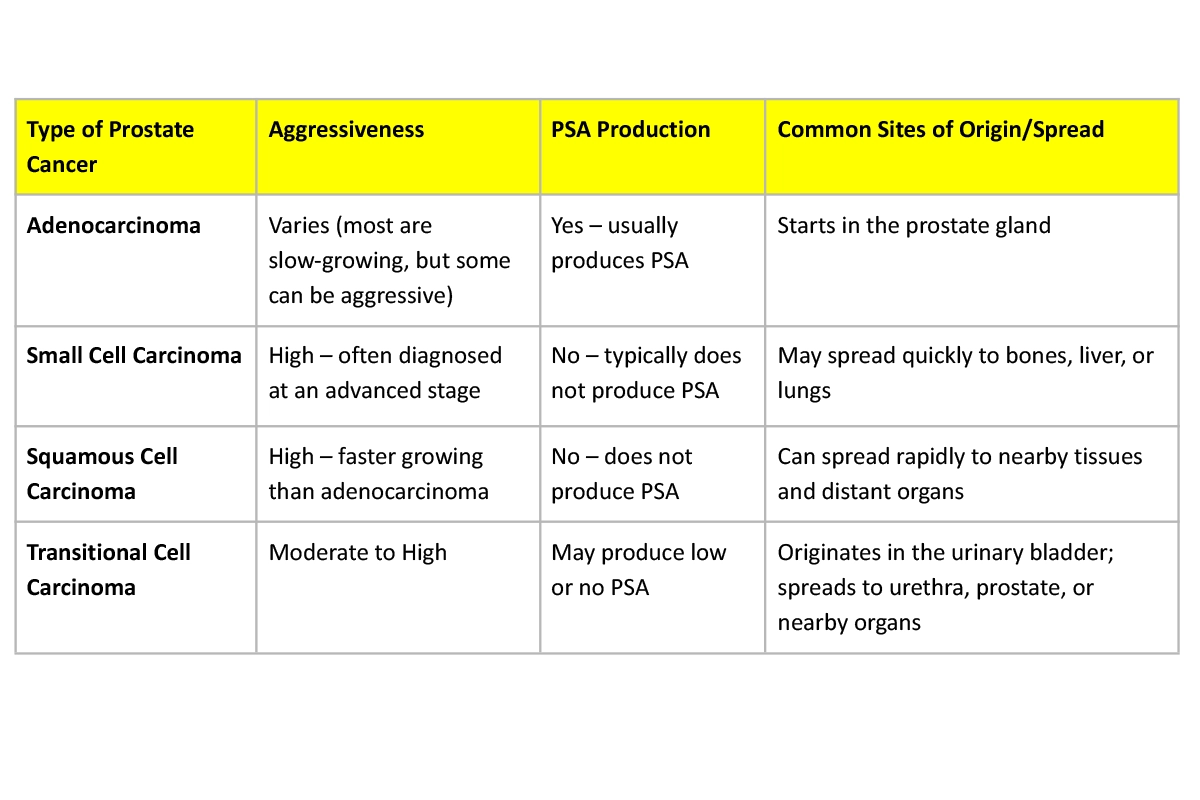
Prostate Cancer Diagnosis: How Is It Detected and Assessed?
Early detection of prostate cancer plays a vital role in improving treatment outcomes and survival rates. Diagnosis typically involves a step-by-step approach combining blood tests, physical exams, imaging, and tissue analysis.
Key Diagnostic Methods
PSA Test (Prostate-Specific Antigen)
A blood test that measures PSA levels, which tend to be elevated in men with prostate cancer.
While not cancer-specific, persistently high or rising PSA levels can prompt further testing.
Digital Rectal Exam (DRE)
A physical exam where a doctor feels the prostate through the rectum to check for lumps or hard areas.
DRE may detect abnormalities not reflected in PSA levels.
Imaging (MRI or Transrectal Ultrasound)
Multiparametric MRI is often used to assess suspicious areas in detail.
Ultrasound may be used during biopsy or when an MRI is unavailable.
Imaging helps determine the extent and location of abnormal tissue.
Prostate Biopsy
A sample of prostate tissue is collected (usually via a needle guided by ultrasound or MRI).
The tissue is examined under a microscope to confirm the presence of cancer cells.
Staging and Grading of Prostate Cancer
Once cancer is confirmed, it’s important to determine how aggressive it is and how far it has spread. This guides treatment planning.
Gleason Score (Grading System)
Assess how abnormal the cancer cells look under a microscope.
Scores range from 6 to 10 (with 6 being low-grade and 8–10 being high-grade).
Higher Gleason scores indicate more aggressive cancer.
TNM Staging System (Tumour–Node–Metastasis)
T (Tumour): Size and extent of the tumour in the prostate.
N (Nodes): Whether cancer has spread to nearby lymph nodes.
M (Metastasis): Whether cancer has spread to other organs, such as bones or lungs.
Prostate Cancer Treatment Options: Comparative Overview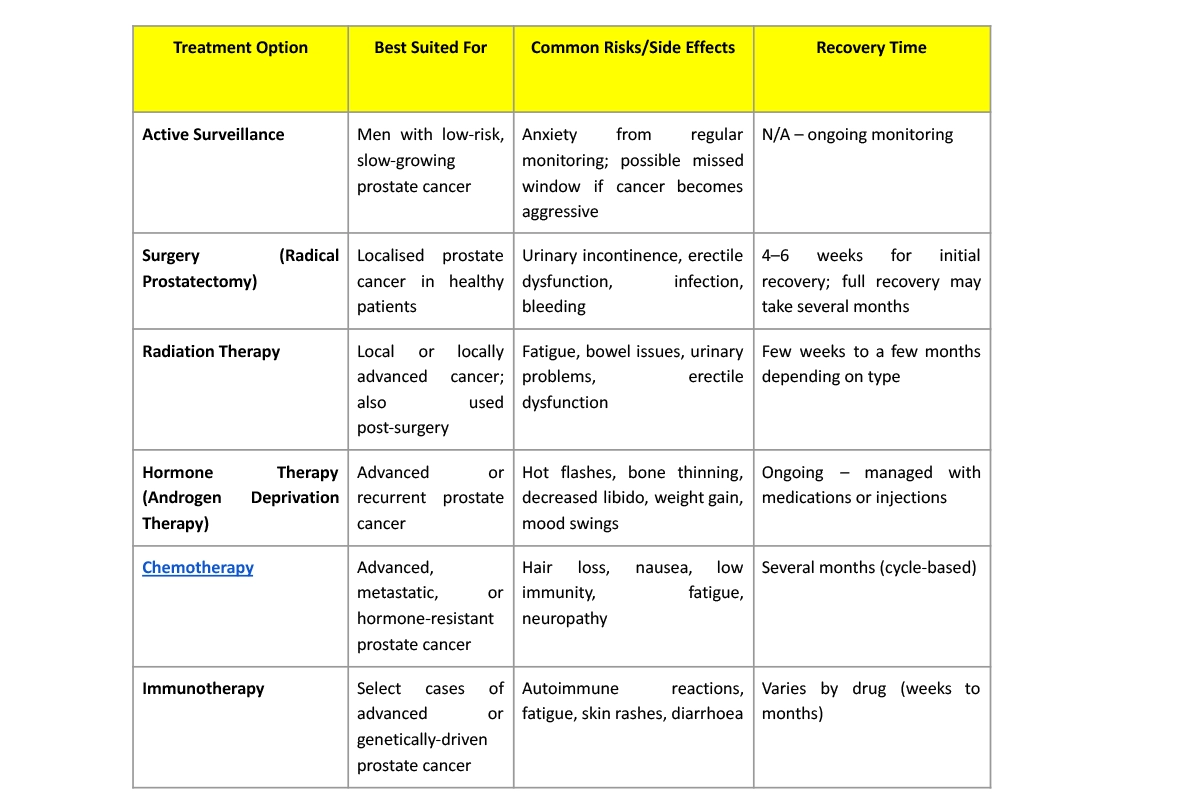
Prostate Cancer Prevention Tips
Prostate Cancer Prevention Tips
Although not all prostate cancers can be prevented, certain lifestyle changes can reduce your risk. Here’s how you can focus on prostate cancer prevention:
Eat a diet rich in fruits and vegetables.
Maintain a healthy weight.
Exercise regularly.
Limit intake of red meat and high-fat dairy.
Avoid smoking.
Get regular screenings after age 50 or earlier if you’re at high risk.
By incorporating these habits, men can potentially lower their risk and detect any problems early.
Prostate Cancer Survival Rate
The prostate cancer survival rate varies based on the stage at which it’s diagnosed:
Localised Cancer: 5-year survival rate is nearly 100%
Regional Spread: 5-year survival is about 99%
Distant Spread (Metastatic): Drops to about 32%
These statistics emphasise the importance of early detection and prompt treatment.
Final Thoughts
Understanding what prostate cancer is, recognising its early symptoms, knowing your risk factors, and exploring available treatment options are essential steps every man should take. With early detection, the chances of successful treatment and long-term survival are significantly higher. Stay informed, prioritise regular health check-ups, and maintain a healthy lifestyle.
For expert diagnosis and world-class treatment, trust the specialised urologists and oncologists at Manipal Hospitals Global. With advanced technology, personalised care, and a patient-first approach, Manipal Hospitals offers comprehensive prostate cancer care tailored to international standards.
Every moment counts. Prostate cancer, when caught early, is highly treatable. Don’t wait for symptoms to take the lead.
Take the first step with Manipal Hospitals Global.
Learn more or book a consultation today.
As a pioneer in healthcare, Manipal Hospitals is among the top healthcare providers in India serving over 250K+ patients annually. Its focus is to develop an affordable, high quality healthcare framework through its multispecialty and tertiary care delivery spectrum and further extend it to out of hospital care. With the completion of acquisition of AMRI Hospitals, the integrated network will have a pan-India footprint of 49 hospitals across 24 cities with 12,600+ beds, and a talented pool of over 11,000 doctors and an employee strength of over 34,000.
Manipal Hospitals provides comprehensive curative and preventive care for a multitude of patients from around the globe. Manipal Hospitals is NABH, AAHRPP accredited and most of the hospitals in its network are NABL, ER, Blood Bank accredited and recognized for Nursing Excellence. Manipal Hospitals has also been recognised the most respected and patient recommended hospital in India through various consumer surveys.
Share this Article


Not sure what you’re looking for?
Not sure what you’re looking for?
Get in touch with our representatives for
help!
Get in touch with our
representatives for help!



