
Kidney Stones Treatment Options for Global Patients
Reviewed by: Nephrology Department
Posted on Mar 02, 2026
8 Min Read

Synopsis
- Understanding Kidney Stones: Why Treatment Differs for Every Patient
- When is Active Treatment Necessary?
- Medical Management: Non-Surgical Kidney Stones Treatment
- Minimally Invasive Surgical Options
- Differences Between the Surgical Techniques
- Recovery and Aftercare
- Special Requirements for Global Patients: What You Need to Do
- Conclusion
Understanding Kidney Stones: Why Treatment Differs for Every Patient
Kidney stones form when minerals and salts in urine crystallise and clump together. Over time, these crystals harden into stones that can remain in the kidney or move into the ureter, the tube connecting the kidney to the bladder.
Not all stones behave the same way. Some remain silent for months. Others cause severe pain, infection, or urinary blockage. That variability is precisely why kidney stones treatment is never one-size-fits-all. Doctors assess the stone’s size, chemical composition, location, and whether complications such as infection or kidney impairment are present before recommending an approach.
When is Active Treatment Necessary?
A small stone may pass on its own, but not every case can be managed at home. Certain clinical signs suggest that medical intervention is essential rather than optional. Active treatment becomes necessary when:
● The stone is larger than 6 mm
● Pain cannot be controlled with oral medication
● There is persistent vomiting or dehydration
● Fever suggests infection
● Kidney function is compromised
● The stone causes complete urinary obstruction
Delaying care in these situations can increase the risk of kidney damage or sepsis. Early evaluation ensures safer outcomes and prevents avoidable complications.
Medical Management: Non-Surgical Kidney Stones Treatment
For smaller stones, conservative care is often effective. This form of kidney stone treatment focuses on helping the body pass the stone naturally while controlling symptoms.
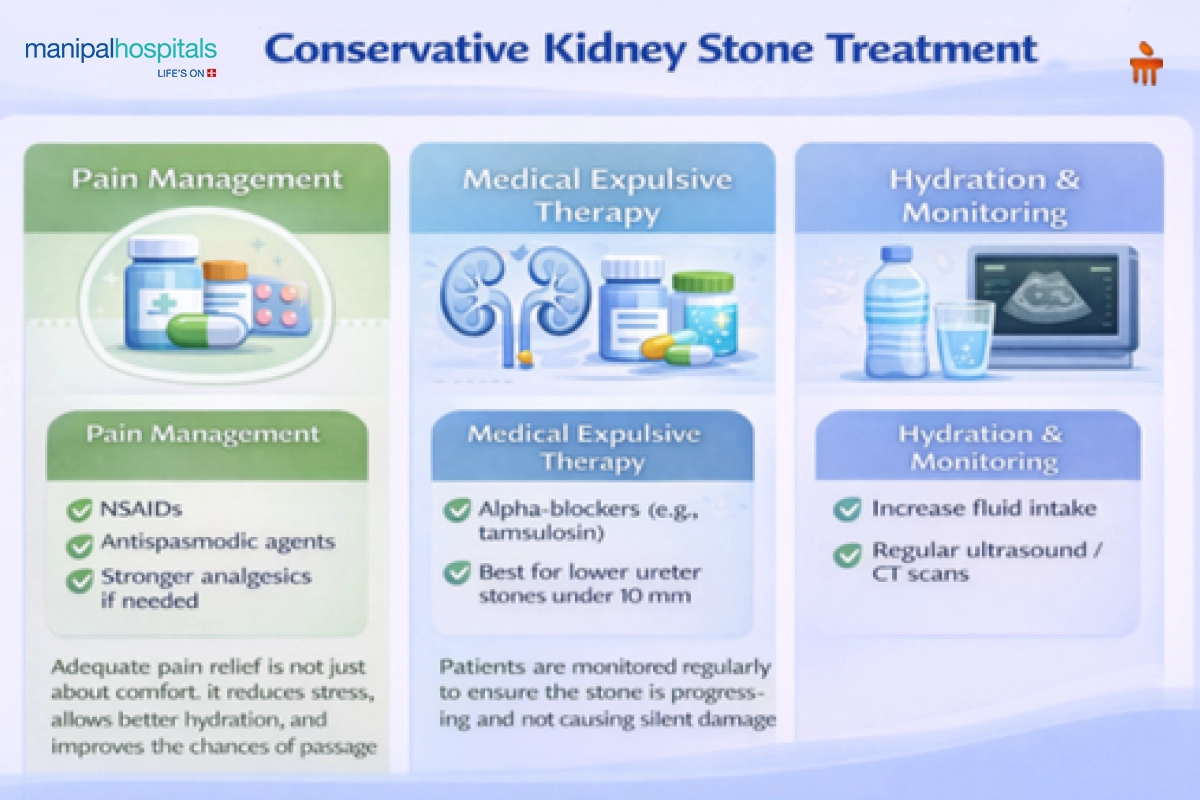
Pain Management
Pain from kidney stones is caused by ureteral spasm and obstruction. Doctors typically prescribe:
● Non-steroidal anti-inflammatory drugs (NSAIDs)
● Antispasmodic agents
● Short courses of stronger analgesics when necessary
Adequate pain relief is not just about comfort. It reduces stress, allows better hydration, and improves the chances of spontaneous passage.
Medical Expulsive Therapy
Certain medications relax the ureter, making it easier for the stone to pass. Alpha-blockers such as tamsulosin are commonly used in appropriate cases. This approach works best for stones located in the lower ureter and typically under 10 mm. Patients are monitored regularly to ensure the stone is progressing and not causing silent damage.
Hydration and Monitoring
Increased fluid intake is encouraged to promote urine flow. However, patients must avoid excessive forced hydration during severe pain episodes, as this can worsen discomfort. Regular imaging, such as ultrasound or CT scans, helps track stone movement. If there is no progress after several weeks, a procedural intervention may be advised.
Minimally Invasive Surgical Options
When stones are too large to pass or cause complications, procedural intervention becomes necessary. Modern urology now offers highly effective and minimally invasive techniques with rapid recovery.
1. Shock Wave Lithotripsy (SWL)
This technique uses focused sound waves to break stones into smaller fragments that can pass naturally. It is performed without incisions and usually as a day-care procedure. SWL works best for stones smaller than 2 cm located within the kidney. However, very hard stones may not fragment efficiently.
2. Ureteroscopy and Kidney Stone Laser Treatment
For many patients today, kidney stone laser treatment has become a preferred option. During ureteroscopy, a thin scope is passed through the natural urinary passage, and no external cuts are made. A laser fibre then breaks the stone into fine particles. This method allows precise targeting, even for stones located deep within the kidney. It is especially useful for hard stones and for patients who have not responded to shock wave therapy. Most patients return home within 24 hours.
3. Percutaneous Nephrolithotomy (PCNL)
For very large or complex stones, PCNL is recommended. A small incision is made in the back to access the kidney directly. Through this tract, instruments remove or fragment the stone. Though more invasive than ureteroscopy, PCNL remains the most effective solution for large stone burdens and staghorn calculi. Hospital stays are usually short, and outcomes are highly successful in experienced centres.
Share this Article


Not sure what you’re looking for?
Not sure what you’re looking for?
Get in touch with our representatives for
help!
Get in touch with our
representatives for help!



