Continuous Renal Replacement Therapy (CRRT): How Continuous Dialysis Operates in Critical Care
Reviewed by: Nephrology Department
Posted on Oct 15, 2026
10 Min Read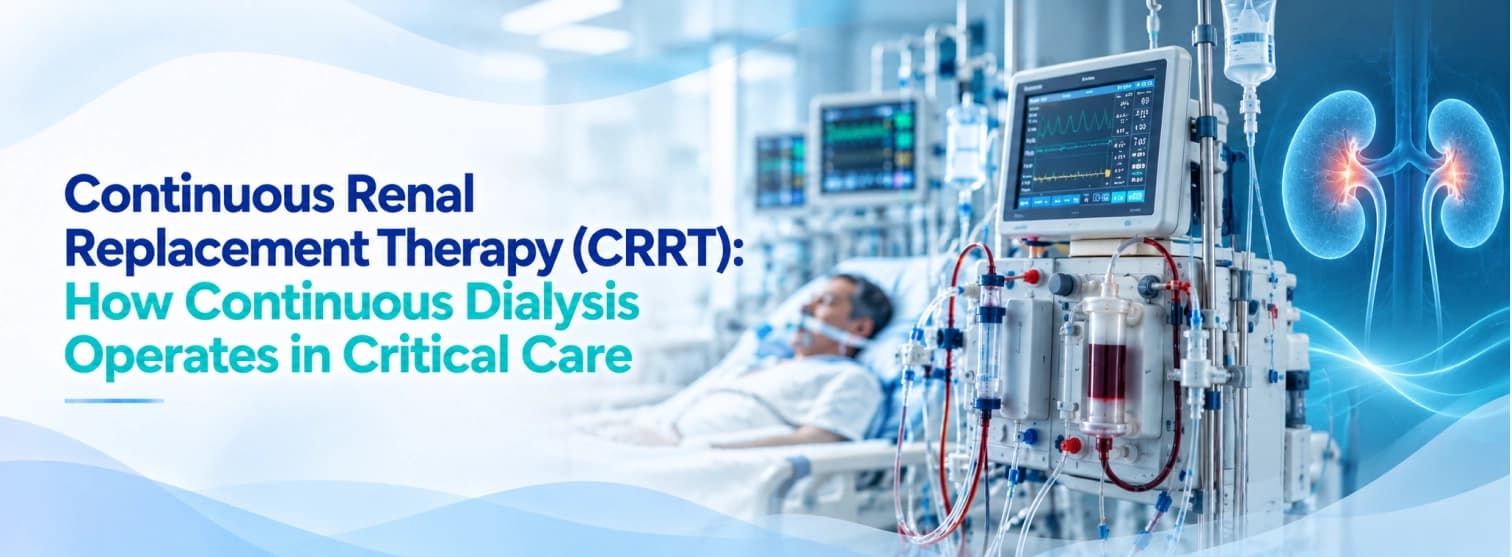
Synopsis
What is Renal Replacement Therapy?
Renal replacement therapy is a medical term for any treatment that takes over the blood-cleansing functions of non-functioning kidneys.
- The human kidneys carry out several continuous physiological tasks:
- They filter metabolic waste products out of circulating blood
- They regulate fluid volume by excreting water in urine
- They maintain serum electrolyte levels within narrow normal ranges
- They help maintain normal acid-base balance by regulating bicarbonate and hydrogen ions
When acute disease or long-standing chronic illness stops the kidneys from doing these jobs, medical interventions must step in. Renal replacement therapy includes different treatment methods, such as intermittent haemodialysis, peritoneal dialysis, continuous blood purification techniques, and renal transplantation.
What is Continuous Renal Replacement Therapy?
Continuous renal replacement therapy, commonly known as CRRT, is a specialised form of dialysis in ICU environments that runs non-stop, 24 hours a day. Unlike standard dialysis treatments that clean blood quickly over three or four hours, CRRT mimics the slow, continuous rate of natural kidneys.
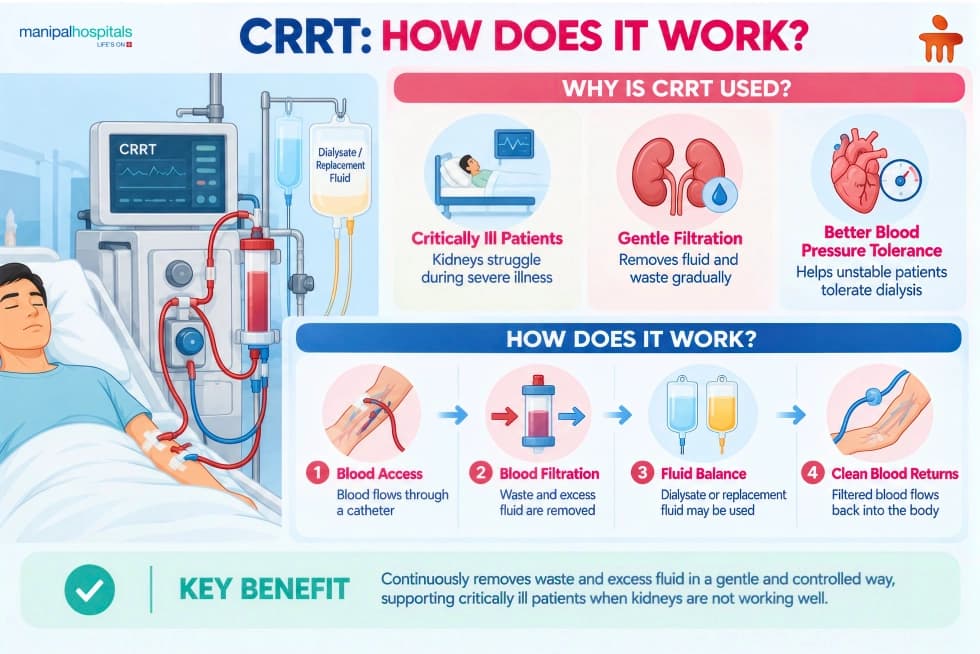
Because the treatment runs continuously, fluid and waste products are removed at a very low, gradual rate. This makes it particularly useful for patients whose cardiovascular system is unstable and who cannot tolerate sudden fluid shifts. It is frequently employed as an acute kidney injury treatment when severe sepsis, systemic inflammatory response syndrome, or cardiac failure causes the kidneys to shut down during an acute hospital admission.
What Are the Different Types of Renal Replacement Therapy?
Renal replacement therapies take over the essential blood-filtering duties of failing kidneys. Depending on the patient's clinical stability, location, and specific therapeutic needs, our specialists at Manipal Hospitals Global utilise three primary modalities:
Therapy Type | How It Works | Best Suited For |
Intermittent Haemodialysis (IHD) | Blood is cycled rapidly through an external dialyser machine for 3 to 4 hours per session. | Stable outpatients with chronic or end-stage kidney failure. |
Peritoneal Dialysis (PD) | Sterile fluid is placed in the abdomen; the body's own abdominal lining (peritoneum) acts as the filter. | Long-term at-home maintenance for independent patients. |
Continuous Renal Replacement Therapy (CRRT) | Blood is gently filtered 24 hours a day bedside in the ICU to mimic natural, continuous kidney function. | Critically ill, unstable patients in the ICU who cannot tolerate rapid fluid shifts. |
Customising CRRT: The Four Specialised Modalities
At Manipal Hospitals Global, we recognise that no two critically ill patients are the same. By utilising these four distinct CRRT modalities, our intensivist and nephrology teams can precisely customise the filtration process, whether a patient needs gentle, isolated fluid extraction, targeted removal of large inflammatory toxins during sepsis, or high-efficiency clearance for complex multi-organ failure. This hyper-targeted approach ensures maximum clinical safety and support when every second counts.
The four main modalities of continuous renal replacement therapy differ in how they remove waste products and excess fluid from the blood.
- Continuous Venovenous Haemofiltration (CVVH): Uses convection to remove waste products and fluid through a filter. Replacement fluid is used.
- Continuous Venovenous Haemodialysis (CVVHD): Uses diffusion to remove waste products across a filter membrane with the help of dialysate.
- Continuous Venovenous Haemodiafiltration (CVVHDF): Combines diffusion and convection to remove waste products, using both dialysate and replacement fluid.
- Slow Continuous Ultrafiltration (SCUF): Primarily removes excess fluid gradually and is not designed for substantial waste clearance.
The appropriate modality depends on the patient's clinical condition and treatment requirements.
Comparison of Primary Renal Replacement Methods
Feature
| Intermittent Haemodialysis (IHD) | Continuous Renal Replacement (CRRT) | Peritoneal Dialysis (PD) |
Best Suited For | Stable outpatients or stable ward patients | Haemodynamically unstable, critically ill ICU patients | Chronic kidney disease patients at home |
Treatment Duration | 3 to 5 hours per session, 3 times a week | Continuous for 24 hours a day over several days | Continuous or cycled daily throughout the day/night |
Primary Clinical Setting | Outpatient dialysis units or stable hospital wards | Intensive Care Units (ICU) | Performed at home by the patient or carer |
Blood Pressure Tolerance | Requires relatively stable cardiovascular function | It may be better tolerated by haemodynamically unstable patients who cannot tolerate rapid fluid shifts. | Well-tolerated haemodynamically |
Fluid Removal Rate | Fast (high volume per hour) | Very slow and steady (low volume per hour) | Slow and continuous |
Vascular Access | Arteriovenous fistula, graft, or central line | Large-bore central venous catheter | Abdominal peritoneal catheter |
How the CRRT Procedure Works
Initiating CRRT dialysis requires specialised machinery, dedicated vascular access, and close nurse monitoring:
- Vascular Access: An intensivist inserts a large-bore, dual-lumen central venous catheter into a large vein, typically the internal jugular vein in the neck or the femoral vein in the groin.
- Connecting the Extracorporeal Circuit: Blood is drawn from one port of the catheter into sterile plastic tubing by a specialised machine pump. The blood flows through a synthetic hollow-fibre hemofilter membrane that filters out water, salts, and small molecules.
- Anticoagulation: Because blood moves slowly through artificial plastic tubing for days, it can easily clot. Doctors use anticoagulants to keep the circuit running. Regional citrate anticoagulation is the preferred clinical approach; citrate is added to the blood as it leaves the body to bind calcium and stop clotting, and calcium is then infused back into the blood before it re-enters the patient. Systemic heparin may be used alternatively in selected cases.
- Fluid Balancing and Return: Depending on the selected mode, replacement fluids and dialysate solutions are delivered into the circuit under strict automated pump control. The cleaned blood is then returned to the patient through the catheter's second port.
Clinical Benefits and Risks of CRRT
Like all advanced intensive care procedures, CRRT carries clear clinical advantages alongside specific medical risks.
Primary Clinical Benefits
- Haemodynamic Tolerance: Because fluid is removed gradually, CRRT may be better tolerated by patients with unstable blood pressure than conventional intermittent dialysis. Blood pressure still requires close monitoring.
- Precise Volume Management: ICU doctors can adjust the fluid removal rate hourly to match the volume of intravenous medications, nutrition, and blood products the patient needs.
- Intracranial Pressure Management: In selected patients with acute brain injury or raised intracranial pressure, CRRT may be preferred because it allows gradual fluid and solute removal. The choice of treatment requires specialist assessment.
- Gradual Electrolyte Correction: CRRT allows controlled correction of electrolyte abnormalities, such as severe hyperkalaemia, and acid-base disturbances. Close monitoring is required to reduce the risk of complications associated with electrolyte shifts.
Associated Risks and Complications
- Bleeding Complications: Using systemic heparin increases the risk of bleeding elsewhere in the body. If citrate is used, patients must be monitored for citrate toxicity or low blood calcium levels.
- Circuit Clotting and Blood Loss: If the filter clots unexpectedly, the blood inside the external tubing often cannot be returned to the patient, contributing to anaemia.
- Hypothermia: Large amounts of blood circulate outside the body and encounter room temperature fluids, which can cause the patient's body temperature to drop unless blood warmers are used.
- Nutritional and Electrolyte Depletion: The filtration process can remove desirable substances, including trace elements, water-soluble vitamins, phosphate, and certain medications like antibiotics, which requires careful dose adjustments.
- Catheter-Related Infections: Central venous lines carry a risk of localised skin infection or bloodstream infections (bacteraemia) if they are left in place for extended periods.
Conclusion
Continuous filtration plays an indispensable role in modern intensive care medicine. When severe illness causes kidneys to stop working in unstable patients, this treatment provides a steady, controlled way to clear toxins, rebalance blood chemistry, and remove excess fluid without causing the sudden drops in blood pressure seen with standard dialysis. While the therapy requires specialised equipment, continuous anticoagulation, and careful monitoring for complications like hypothermia and catheter infections, it gives critically ill patients the time their kidneys need to recover from acute injury.
Advanced CRRT in Critical Care for International Patients: Continuous Dialysis at Manipal Hospitals Global
At Manipal Hospitals Global, Nephrology Department, we understand that when a loved one is in the Intensive Care Unit (ICU), time is critical. In cases of critical illness, septic shock, or multi-organ failure, the kidneys are often the first organs to struggle, leading to a dangerous build-up of toxins and fluid.
For haemodynamically unstable patients, standard dialysis is too rapid and stressful for the heart. That is where Continuous Renal Replacement Therapy (CRRT) comes in. For patients who are critically ill or haemodynamically unstable, Continuous Renal Replacement Therapy (CRRT) allows blood to be filtered continuously, supporting gradual fluid and waste removal under close medical monitoring.
Share this Article


Not sure what you’re looking for?
Not sure what you’re looking for?
Get in touch with our representatives for
help!
Get in touch with our
representatives for help!