Transcatheter Aortic Valve Replacement (TAVR): Procedure, Benefits, and Recovery
Reviewed by: Cardiothoracic Vascular Surgery Department
Posted on Nov 18, 2026
8 Min Read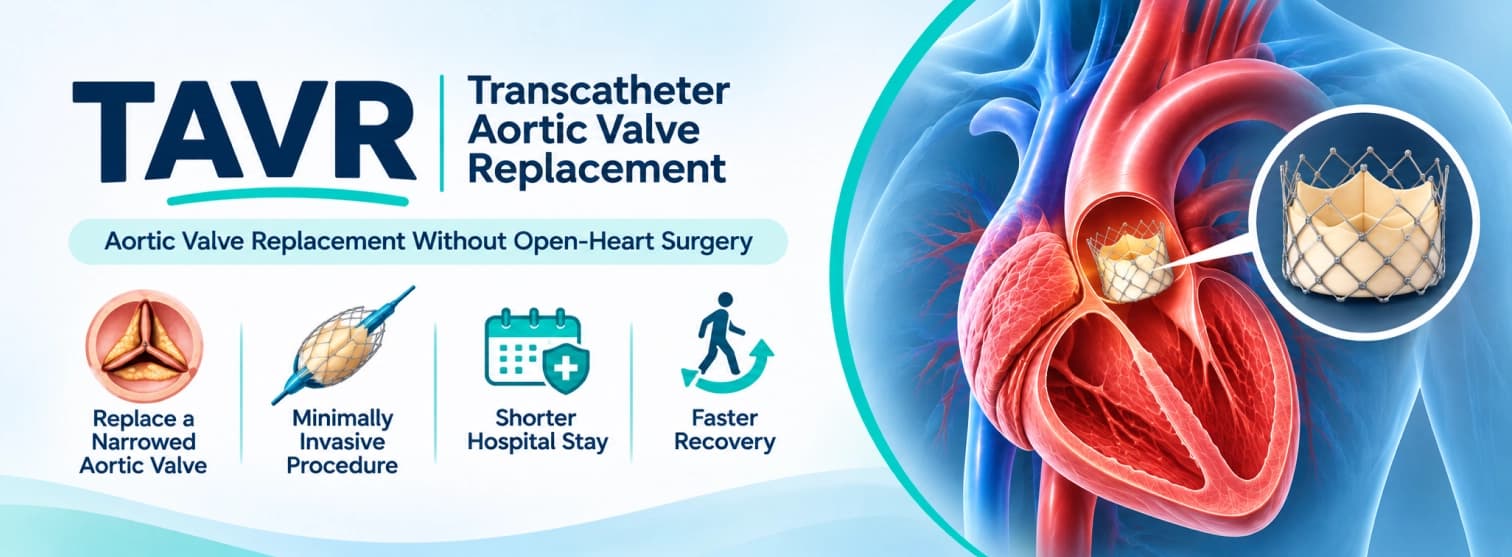
Synopsis
Understanding Aortic Stenosis and Aortic Valve Replacement
The aortic valve acts as the primary doorway between your heart and the rest of your body. Sitting between the left ventricle (the main pumping chamber) and the aorta (the main artery supplying oxygen-rich blood), it features three flexible tissue flaps called leaflets that open wide with every heartbeat and seal tightly shut between beats.
As people age, calcium deposits can build up on these delicate tissue flaps, causing them to stiffen and thicken. Over time, the valve opening narrows down to a tiny slit, a condition called severe aortic stenosis. When the valve cannot open fully:
- The heart muscle has to pump against immense resistance to push blood out.
- The left ventricle thickens (hypertrophy) and tires out.
- The brain and body receive less oxygenated blood, leading to breathlessness, chest tightness (angina), dizziness, and fainting episodes.
- Left untreated after symptoms appear, severe aortic stenosis carries an alarming mortality rate, with nearly 50% of symptomatic patients dying within two years without valve replacement.
The TAVR procedure solves this mechanical bottleneck by placing a new, functioning tissue valve directly inside the diseased native valve, pushing the old calcium deposits aside and restoring effortless forward blood flow.
What Is the TAVR Procedure?
Transcatheter aortic valve replacement is an advanced, image-guided technique that achieves aortic valve replacement without open-heart surgery. Instead of cutting open the breastbone (sternum) and temporarily stopping the heart, an interventional cardiology team uses a catheter (a thin, flexible tube) inserted into an artery, usually the femoral artery in the groin.
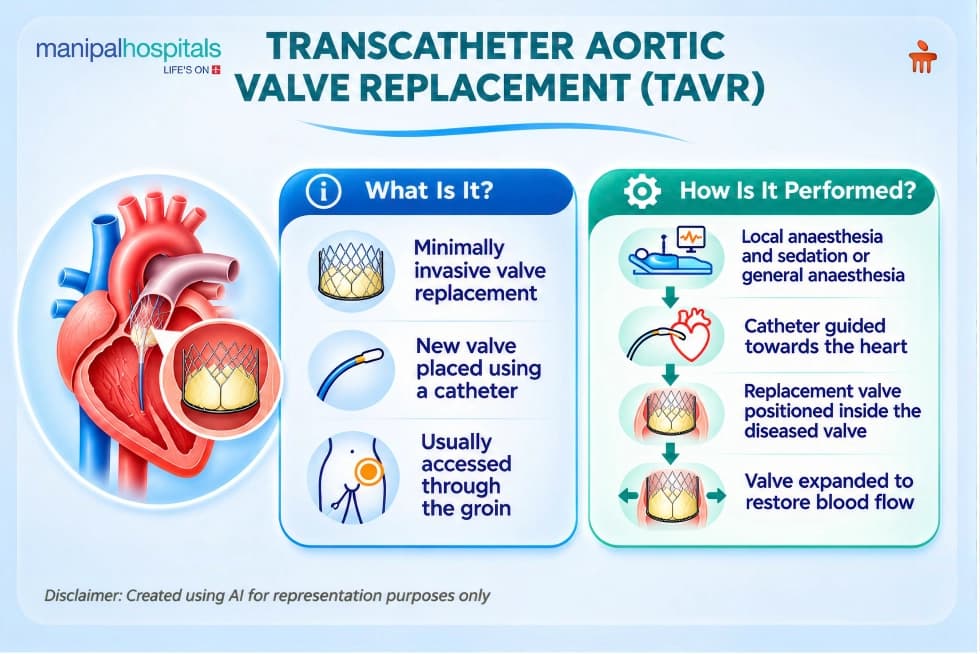
The replacement valve is built from biological pericardial tissue (harvested from bovine or porcine sources) mounted securely within a stent frame made of expandable metal mesh. Once navigated into the heart, the artificial valve expands, locks into the aortic ring, and begins working immediately.
Determining TAVR Eligibility
Deciding whether a patient is a good candidate for TAVR surgery is handled by a multidisciplinary heart team, including interventional cardiologists, cardiothoracic surgeons, cardiac imaging specialists, and cardiac anaesthesiologists. Key factors that guide TAVR eligibility include:
Symptoms: Severe aortic stenosis accompanied by exertional breathlessness, chest pain, profound fatigue, or syncope.
- Surgical Risk: TAVR is approved first for patients in whom surgery is not recommended or who are at high risk (usually 70 years old or older, prior history of open heart surgery, frailty, severe chronic obstructive pulmonary disease [COPD], or kidney failure). However, several clinical trials have demonstrated that it can be safely performed on intermediate and some lower-risk patients.
- Importance of Vascular Anatomy: Pre-procedure CT angiography must carefully map the iliofemoral arteries of the leg and pelvis. The vessels should be sufficiently large (usually 5 to 5.5 mm in diameter) and not overly tortuous or calcified to allow passage of the delivery catheter.
- Aortic Root: The CT scan evaluates the size of the aortic annulus, the height of the coronary ostia (to prevent accidental obstruction), and the distribution of calcium near the valve.
- Other Access: Patients whose arteries in the legs are too small or diseased may have other locations chosen for access by the Heart Team, such as the subclavian artery (or axillary artery) near the shoulder or the carotid artery in the neck.
How the Procedure Works: Step by Step
Performed in an advanced Cardiac Catheterisation Laboratory (Cath Lab) or Hybrid Operating Theatre, the TAVR procedure takes 45 to 90 minutes from start to finish:
- Sedation: Most patients only require local anaesthetic and sedation so they are calm and breathing without the aid of a ventilator.
- Arterial Access: The doctor creates a small 5-6 mm puncture in the femoral artery in the groin.
- Crossing the Valve: Under echo and fluoroscopy guidance, a thin guide wire is passed down the aorta and across the stenotic valve.
- Pre-dilation: If the native valve is very calcified, a small balloon is inflated briefly to make a path.
- Valve Deployment: The new valve (an anatomically based valve mounted on a self-expanding or a balloon-expanding metal frame) is deployed and expanded. It sits securely in the aortic root and displaces the faulty native leaflets.
- Measure and Check: internal pressures and echocardiography are checked to ensure constant forward flow without leaks. The delivery catheter is then removed, and the groin puncture site is closed with closure devices to avoid sutures through the skin.
TAVR vs Open Heart Surgery
Evaluating TAVR vs open heart surgery (SAVR) highlights why catheter-based aortic valve replacement without open heart surgery offers a gentler recovery:
Parameter | TAVR | SAVR (Open Heart Surgery) |
| Incision | 5 to 6 mm groin puncture | 15 to 20 cm chest sternotomy |
| Heart-Lung Machine | Not needed; the heart beats naturally | Required; heart is stopped temporarily |
| Anaesthesia | Local anaesthesia with light sedation | General anaesthesia with breathing tube |
| Procedure Duration | 45 to 90 minutes | 3 to 5 hours |
| Hospital Stay | 2 to 3 days | 6 to 10 days |
| Initial Recovery | 1 to 2 weeks | 8 to 12 weeks |
| Ideal Profile | Seniors (70+) and high or moderate surgical risk | Younger patients (<60) or multi-valve disease |
Understanding Potential TAVR Risks
While TAVR surgery avoids the trauma of a sternotomy, it remains a major structural intervention. Documented TAVR risks include:
- Heart Rhythm Changes: The expanding frame can press on nearby electrical pathways. Between 8% and 15% of patients need a permanent pacemaker to keep their rhythm regular.
- Vascular Injury: Passing delivery sheaths through narrow or calcified leg vessels can occasionally cause bleeding or local haematomas at the groin site.
- Paravalvular Leaks: Small gaps can form around the outer frame if calcium deposits are uneven, though modern skirted valves have made significant leaks uncommon.
- Stroke Risk: Crossing a calcified valve can dislodge microscopic flecks. Specialists often use temporary cerebral embolic filters in the neck vessels to catch debris before it reaches the brain.
- Kidney Stress: The contrast dye used for imaging can stress vulnerable kidneys, which clinical teams manage with proactive intravenous hydration.
TAVR Recovery Time: What to Expect
The overall TAVR recovery time is measured in days rather than months, helping patients regain their independence quickly:
- Days 1 to 3 (Hospital): Patients rest flat for 4 to 6 hours so the groin puncture seals cleanly. Most walk the following morning comfortably, notice lighter breathing right away, and head home within 48 to 72 hours.
- Weeks 1 to 4 (Home): Light daily activities, gentle walking, and stair climbing resume immediately. Avoid lifting objects over 5 kg during the first week. Most people return to driving and social routines within 2 to 4 weeks.
- Long-Term Protection: Patients take daily blood thinners (such as aspirin) to protect the biological leaflets, accompanied by scheduled checkups and annual echocardiograms.
Conclusion
Transcatheter valve therapy has transformed aortic stenosis care, offering an effective treatment option that can improve blood flow without the need for conventional open-heart surgery. By replacing a damaged valve through a minimally invasive, catheter-based procedure, TAVR can help eligible patients experience symptom relief, shorter hospital stays and a faster return to daily activities. The Cardiology Department at Manipal Hospitals Global brings together experienced cardiac specialists and advanced diagnostic facilities to support comprehensive heart care, from evaluating TAVR eligibility and pre-procedure CT planning to treatment and personalised cardiac rehabilitation. For expert assessment and guidance, consult the cardiology team at Manipal Hospitals Global.
Share this Article


Not sure what you’re looking for?
Not sure what you’re looking for?
Get in touch with our representatives for
help!
Get in touch with our
representatives for help!