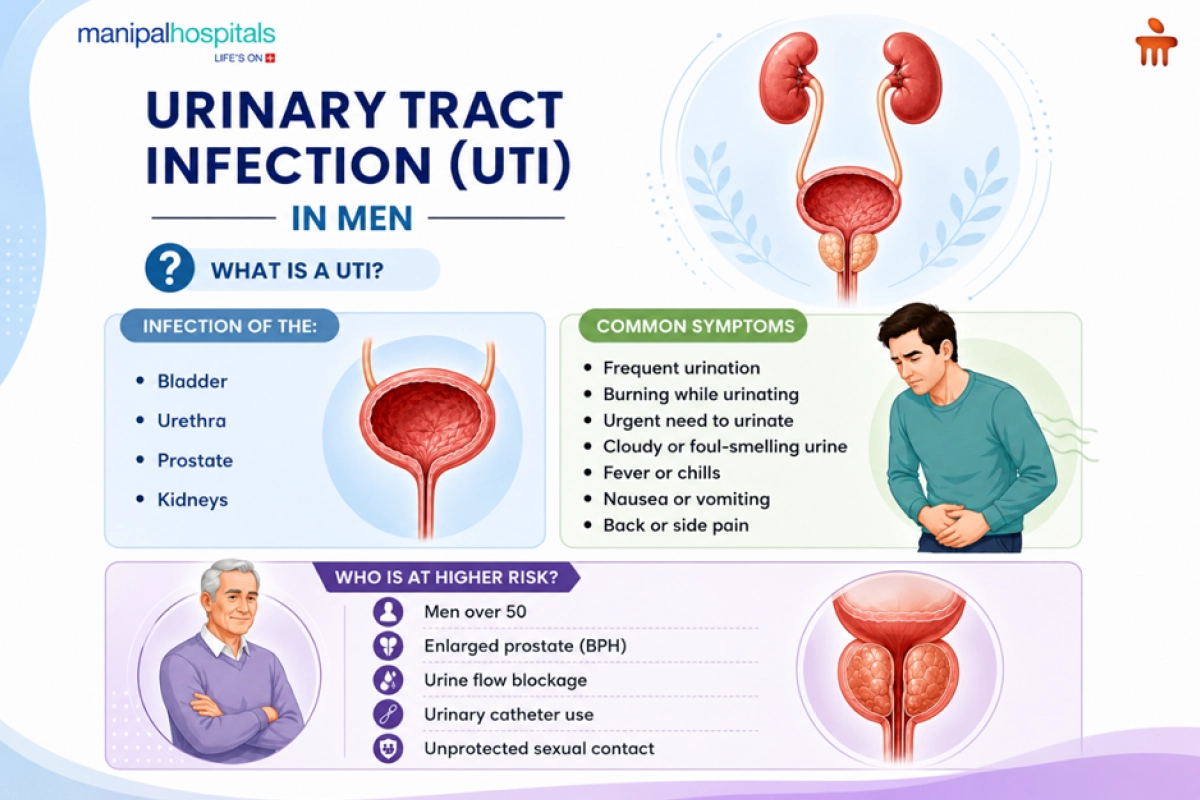
A urinary tract infection (UTI) in men is less common than in women but can become serious if left untreated. Recognising the symptoms of UTI in men early and seeking prompt treatment helps prevent complications.
You might notice a burning feeling when you pass urine or an urge to go again just minutes after you have emptied your bladder. It is easy to push these signs aside at first, telling yourself it will pass. But when the discomfort lasts or gets worse, it can start to affect your sleep, your work, and your peace of mind.
Urinary tract infections are often talked about as something that mostly affects women, but men get them too, and ignoring the signals can allow a simple infection to turn into something more serious. About 12% of men will experience a urinary tract infection (UTI) at some point in their lives. While the condition is relatively rare in younger men, the likelihood of developing an infection rises significantly after age 50. This blog explains UTI in men, the common symptoms of UTI in men, what causes a UTI in men, available treatment options, and ways to prevent future infections.
The urinary system comprises a network of organs working together to filter waste products from your blood and carry them out of your body. This system includes your kidneys, the twin tubes called ureters, your bladder, and the urethra. In men, the urethra is a single tube that passes directly through the prostate gland to the tip of the penis.
An infection develops when unhealthy bacteria enter this system and begin to multiply. Because the male urethra is significantly longer than the female urethra, bacteria have a much greater physical distance to travel to reach the bladder.
Types of UTI in Men
Medical professionals divide these infections into two primary categories based on where the bacteria are growing within your system.
Classification
Affected Anatomical Areas
Common Complications
Typical Management Focus
Lower Tract Infection
Bladder (Cystitis), Urethra (Urethritis), or Prostate (Prostatitis).
Localised inflammation and discomfort during urination.
Short-term targeted medication and increased fluid intake.
Upper Tract Infection
Ureters and the Kidneys (Pyelonephritis).
High fever, potential tissue scarring, or systemic infection risk.
Extended medication courses and close clinical observation.
What are signs of a UTI in men?
An infection within the urinary system usually causes a clear set of localised changes that disrupt your normal bathroom routine. Depending on whether the infection sits in the lower or upper tract, you may notice different physical responses.
The most frequent symptoms of a UTI in men include the following:
An unusually frequent or urgent need to urinate, even when your bladder is nearly empty.
A sharp pain, burning sensation, or general discomfort during or immediately after passing urine.
Urine that looks cloudy or dark or carries a strong, foul odour.
Traces of blood in the urine, which can make it look pink or tea-coloured.
A feeling of pressure, pain, or tenderness in the lower abdomen, below your navel.
You may also wake up multiple times during the night to pass urine.
If the bacteria travel past the bladder and reach the kidneys, they trigger an upper tract infection.
Causes and Risk Factors of UTI in Men
Bacterial entry into the male system is usually linked to specific physical factors or underlying health changes that disrupt the natural downward flow of urine. When looking into what causes UTI in men, the primary triggers are often divided by age groups:
Infections in Younger Men: For men under the age of 50, standard bacterial entry is less common. In this age group, urinary issues are frequently driven by sexually transmitted infections (STIs), such as chlamydia or gonorrhoea, which inflame the lining of the urethra.
Prostate Enlargement: In men over 50, the most frequent driver is benign prostatic hyperplasia (BPH). As the prostate gland naturally expands with age, it presses against the bottom of the bladder and constricts the urethra. This partial blockage prevents the bladder from emptying completely, leaving stagnant urine behind where bacteria can quickly multiply.
Physical Obstructions: Structural issues like kidney stones or a narrowing of the urethra due to old scar tissue can physically block urine flow, creating an ideal environment for bacterial growth.
Medical Interventions: The use of rubber catheter tubes to drain the bladder during a hospital stay or recent surgical checks on the urinary tract can inadvertently introduce external bacteria into the system.
Systemic Conditions: Chronic health issues like diabetes weaken the body's natural immune response, making it harder for your system to clear out low-level bacterial counts before they become established.
How Is UTI in Men Diagnosed?
1. Urinalysis and Microscopic Check
You provide a clean-catch urine sample at the clinic. A laboratory technician checks the sample under a microscope to look for high counts of bacteria and white blood cells, which confirm an active infection
2. Urine Culture Analysis
The laboratory performs a culture test on the sample to grow and isolate the specific strain of bacteria causing your infection. This step identifies exactly which medications will be most effective.
3. Prostate Evaluation via Rectal Examination
For older men, a physician performs a brief physical check to evaluate the size, shape, and firmness of the prostate gland, determining if a structural blockage is trapping urine in the bladder.
4. Advanced Structural Imaging
If a young man develops an infection without an obvious cause, or if infections keep returning, a doctor may order an ultrasound, a CT scan, or a cystoscopy to look for underlying anatomical variations.
Treatment Options for UTI in Men
Because these infections are bacterial, they cannot be resolved with home remedies alone. Doctors rely on targeted antibiotics for UTI in men to eliminate the bacteria completely. The length of your medication course depends entirely on the location and severity of the infection. A standard, uncomplicated lower tract infection is usually cleared with five to seven days of oral tablets.
However, if the infection has spread to the prostate gland or reached the kidneys, the tissue requires a longer recovery window; your doctor may prescribe a continuous course of medication lasting three weeks or more.
Home Care Tips During UTI Recovery
While medication treats the root cause, simple daily self-care habits can ease your discomfort and assist your recovery:
Increase Your Water Intake: Drinking plenty of water dilutes your urine and encourages frequent urination, which helps flush bacteria out of your tract naturally.
Avoid Bladder Irritants: Temporarily cut out caffeine, alcohol, carbonated drinks, and heavily spiced foods from your diet, as these compounds can irritate the lining of an inflamed bladder.
Use Warmth for Comfort: Placing a heating pad or a warm compress on your lower abdomen can help soothe pelvic pressure or deep muscle aches.
Review the Cranberry Evidence: While drinking unsweetened cranberry juice is a popular lifestyle choice, large clinical reviews show limited evidence that it can treat an active infection compared to simple water. It is safe to include, but it does not replace medical care.
Prevention Strategies
Taking small, proactive steps can significantly lower the risk of developing future urinary complications. If you want to know how to prevent UTI in men, focus on these practical guidelines:
Maintain steady hydration throughout the day to keep your urinary tract clearing naturally.
Do not delay using the bathroom or hold your urine for long periods when you feel the urge to go.
Practise good personal hygiene and wash your hands thoroughly after using the bathroom.
Use condoms during sexual activity to protect against infections that damage the urethral lining.
Address early signs of prostate enlargement, such as a weak urine stream or straining to start, with a specialist before it causes a complete blockage.
Why Choose Manipal Hospitals Global for Male Urinary Health?
Urinary tract infections in men often require more than symptom relief; they need an accurate diagnosis to identify the underlying cause and prevent recurrence. At Manipal Hospitals Global, our experienced urologists combine advanced diagnostics with evidence-based treatment plans to ensure timely and effective care for every patient.
Our comprehensive approach includes:
Expert evaluation by experienced urologists for simple and complex urinary tract infections.
Advanced diagnostic facilities, including urine culture, imaging, and endoscopic evaluation when required.
Personalised treatment plans, including targeted antibiotic therapy and management of underlying conditions such as enlarged prostate, kidney stones, or recurrent infections.
Minimally invasive urological procedures whenever indicated for faster recovery and improved outcomes.
Multidisciplinary support from nephrology, radiology, microbiology, and infectious disease specialists for comprehensive care.
Dedicated international patient services, including virtual consultations, treatment planning, visa assistance, interpreter services, and personalised care coordination for patients travelling to India.
Conclusion
Urinary tract infections are less frequent in men, but they remain a distinct physical issue that should never be ignored. Left untreated, a simple lower tract infection can migrate upward into the kidneys, leading to more serious long-term complications. If you experience symptoms such as burning urination, frequent urination, blood in the urine, or fever, consult a urologist promptly for an accurate diagnosis and timely treatment.
Recognising the signs early and securing proper medical evaluation allows the problem to be cleared quickly and safely. Manipal Hospitals Global provides comprehensive diagnostic testing and specialised treatment for urinary tract infections in men. Our expert team ensures accurate diagnosis, effective treatment, and personalised care for lasting urinary health.